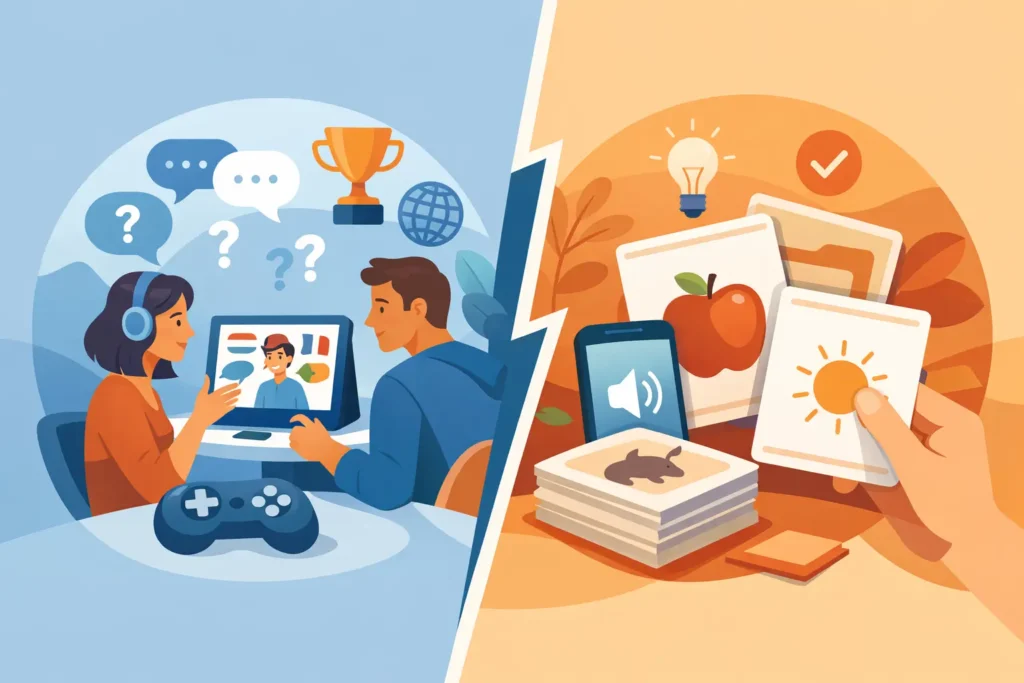
A language game versus flashcards is not really a fight between fun and discipline. It is a question of what kind of learning you need at a given moment. Flashcards can put a word in your memory fast. A well-designed game can make you recognize it under pressure, connect it to meaning, and want to come back tomorrow. For learners who want more from screen time than another streak counter, that distinction matters.
The strongest language-learning routine does not worship one tool. It uses each tool for the job it can actually do. The goal is not to collect vocabulary like trading cards. The goal is to understand, recall, and use a language when the answer is not printed on the back of a card.
What Flashcards Do Exceptionally Well
Flashcards earned their reputation for a reason. They are direct, efficient, and built around active recall. You see a prompt, reach for the answer, and find out whether you knew it. That small act of retrieval strengthens memory more than simply rereading a word list.
They are especially useful when you need to build a base of high-frequency words, characters, phrases, or verb forms. A learner beginning Japanese might use cards to establish common kana or essential vocabulary. Someone preparing for a class exam might drill the terms that will appear on a quiz. There is very little friction between deciding what to study and studying it.
Spaced repetition makes this even more powerful. When cards return just before you are likely to forget them, review time can be focused where it matters. That is a smart system for retaining isolated facts, particularly when the material has a clear right answer.
Flashcards also give learners control. You can add a word you heard in a show, a phrase from a textbook, or a mistake from a conversation. For motivated students, that flexibility is a major advantage.
Where Flashcards Start to Lose Momentum
The problem is not that flashcards are ineffective. The problem is that language is bigger than recognition in a tidy prompt-response loop.
A card can tell you that 火 means fire. It cannot, by itself, teach you how quickly you need to recognize it in a crowded interface, which nearby words change its meaning, or whether you can retrieve it when a conversation moves on without waiting for you. A stack of cards can create familiarity that feels like fluency, even when the learner cannot use the language beyond the deck.
Motivation is another weak point. Repetition is necessary, but repetition without a compelling reason to continue becomes a negotiation with yourself. Learners often begin with a heroic review goal, miss a few days, watch the backlog grow, and quit because study now feels like debt.
That is not a character flaw. It is a design problem. Human attention responds to progress, surprise, challenge, and feedback. Traditional flashcards offer some of that, but their central loop rarely changes. The learner does the work because they value the future result, not because the activity itself creates much momentum.
Language Game Versus Flashcards: The Real Difference
A language game changes the role vocabulary plays. Instead of being the whole activity, language becomes the tool used to solve a puzzle, make a choice, survive an encounter, recognize a pattern, or advance through a world.
That shift can create richer memory. When a word appears during a meaningful decision, it is attached to an outcome. When a learner sees a phrase repeatedly across varied situations, they begin to understand its function rather than only its translation. Context gives vocabulary handles to grab onto.
Good games also create desirable difficulty. The player has to pay attention, make predictions, and respond before the moment passes. That is more demanding than tapping “easy” or “hard,” but it can be more memorable because the brain is working with the information rather than merely reviewing it.
Play makes repetition easier to return to
Games are not magic because they have points, sound effects, or a leaderboard. Those can become empty decoration fast. The valuable part is a gameplay loop that makes repeated contact with language feel purposeful.
A puzzle can ask players to spot meaningful patterns. A role-playing system can make vocabulary useful for choices and strategy. A timed challenge can train quick recognition. Progression can give learners a visible sense that their growing knowledge has changed what they can do.
This matters on the fourth, tenth, and thirtieth session, when novelty has worn off. A game that remains engaging gives learners more chances to meet the material. More meaningful encounters generally beat a perfect study plan that gets abandoned after a week.
Context builds more usable knowledge
Language is full of ambiguity. The same word can carry different meanings depending on the sentence, speaker, setting, or tone. Flashcards can include example sentences, images, and audio to address this. A thoughtful deck is much better than a bare translation pair.
Games can go further by making context interactive. The learner does not just read an example. They use clues to infer meaning, test a choice, and see a consequence. This does not replace grammar explanation or deliberate practice, but it can make abstract knowledge stick.
For beginners, that may mean connecting a word with an image and a simple action. For more advanced learners, it may mean navigating dialogue, recognizing nuance, or selecting language that fits a social situation. The best learning games scale the challenge without treating every player like a beginner forever.
Games Are Not Automatically Better
A language game can fail just as easily as a flashcard deck can. If the language content is disconnected from the gameplay, players may learn how to win without learning much else. If rewards arrive regardless of attention, the game trains persistence but not recall. If the challenge is too easy, it becomes passive entertainment wearing an educational costume.
There is also a practical trade-off. Flashcards are still hard to beat for targeted review. If you keep confusing two verb endings or need to memorize specialized vocabulary for a test, a focused deck can be the fastest route. A game may provide broad exposure, but it may not show a specific weak item as often as you need it.
The question is not whether games are superior in every situation. Ask whether the game requires the kind of thinking you want to improve. Does it ask you to notice language, retrieve it, and apply it? Does feedback explain mistakes or merely mark them wrong? Does progress reflect actual learning, not just time spent tapping?
Choose the Tool Based on the Learning Job
Use flashcards when you need efficient recall of a defined set of words, symbols, or forms. They are ideal for short review sessions, exam preparation, and repairing a narrow knowledge gap. Keep them lean, use audio and examples where possible, and avoid adding so many cards that review becomes punishment.
Use games when you need consistency, context, recognition speed, and a reason to stay engaged. They are particularly valuable for learners who have tried to force themselves through decks and found that their routine disappears the moment life gets busy. A game can turn repeated exposure from a chore into part of a daily ritual.
Use both when you want the strongest long-term system. A game introduces and reinforces language through action. Flashcards catch the terms that still refuse to stick. Reading, listening, speaking, and writing then move that knowledge into the real world. Each tool covers a different part of the path.
This is the design philosophy behind the work at Riot Shield Games: gameplay should not be a sugar coating poured over study. It should be part of how learning happens. A great game gives players a reason to think, try again, and improve. Educational value follows from mechanics that demand attention and reward growth.
Build a Routine You Will Actually Keep
Start small enough that you can repeat it. Fifteen minutes of a language game after lunch and five minutes of targeted flashcard review before bed can outperform an ambitious two-hour plan that only happens on Sundays. Track more than streaks. Notice whether you are recognizing words faster, understanding them in new settings, and recalling them without a prompt.
When a game introduces a word that keeps appearing, add it to a personal review deck. When a flashcard feels flat or confusing, find it in a sentence, a song, a conversation, or a game scene. Give the word a job beyond being an answer.
The right tool is the one that moves you from “I have seen this” to “I can use this.” Make your study time playable, make your play time meaningful, and let every session leave you a little smarter than when you started.