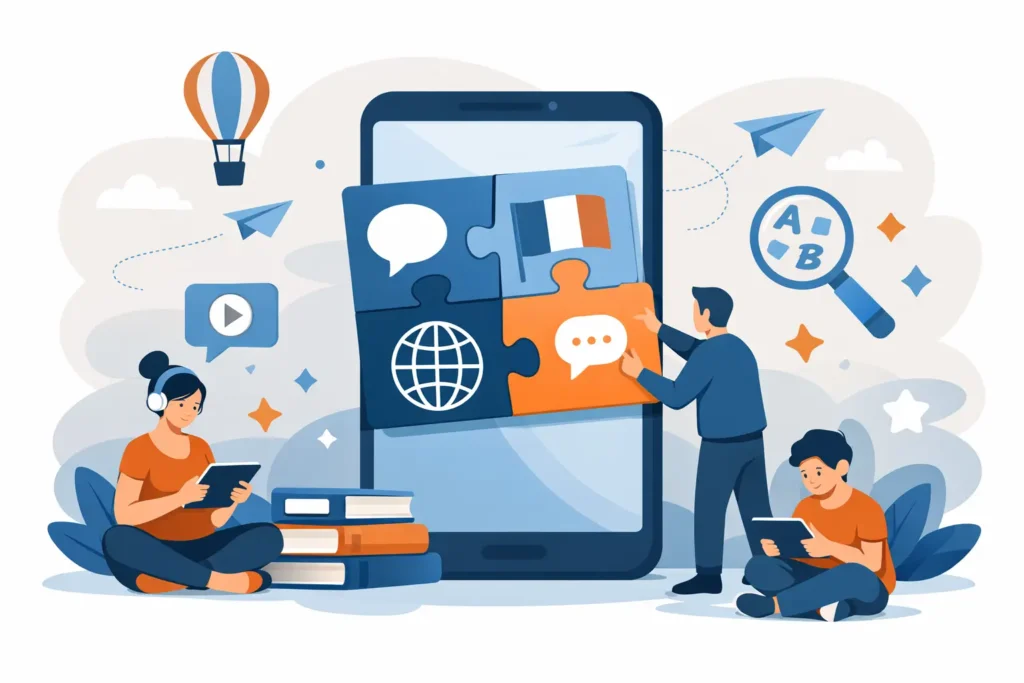
A missed train. Five spare minutes. A phone in your hand. That is where language puzzle apps make their strongest case: not as a replacement for every part of language study, but as a smarter use of the moments when a textbook would never come out.
The best games do more than put vocabulary on colorful tiles. They give words a job to do. You match a character to its meaning because the next move depends on it. You recognize a pattern because it helps you solve a board. You return tomorrow because you want to beat your score, not because an app scolded you about a streak.
That shift matters. Learning a language takes repetition, but repetition does not have to feel repetitive. Good game design can turn recall, recognition, and pattern spotting into the core loop of play.
What Language Puzzle Apps Should Actually Do
A language game is not automatically a learning game just because it includes foreign words. Plenty of apps use a few translations as decoration around a familiar puzzle mechanic. They may be fun, and fun has value, but entertainment alone does not guarantee that vocabulary will stick.
A stronger language puzzle app makes the learning objective inseparable from progress. If you cannot tell one Japanese character from another, read a Mandarin word accurately, or connect a term to its meaning, you cannot consistently make the best move. Knowledge becomes useful inside the game.
That creates a healthier kind of friction than rote drills. Instead of asking, “Can you memorize this list?” the game asks, “Can you use what you know to solve this problem?” The player gets immediate feedback, a reason to try again, and a visible sense of improvement.
For learners, that means puzzle games are especially good at building early confidence. They can make a new writing system feel less intimidating, strengthen recognition of high-frequency vocabulary, and create repeated encounters with words before learners are ready to use them in open conversation.
Why Puzzles Can Build Better Recall
Memory improves when the brain has to retrieve information rather than simply look at it. A well-designed puzzle creates that retrieval moment again and again. You see a prompt, scan possible answers, make a choice, and learn whether your choice worked. That small cycle is powerful because it asks for active participation.
Puzzles also add context through constraints. In a match game, the board limits what can pair together. In a word-building game, available letters narrow the possibilities. In a logic puzzle, each correct answer reveals information about the next one. These constraints give the learner meaningful cues, which are far more memorable than a word appearing alone on a flashcard.
There is also an emotional advantage. A correct answer can feel like a victory because it unlocks a chain reaction, clears a difficult board, or saves a run. That positive feedback does not replace deliberate study, but it can make the repetition required for learning far easier to sustain.
The trade-off is that games can create familiarity without full command. Recognizing a word in a puzzle is not the same as producing it aloud in a conversation. Players who want broad fluency still need listening, speaking, reading, and real-world exposure. Puzzle apps work best as a high-engagement layer in a wider learning practice.
The Difference Between a Time-Filler and a Learning System
The question is not whether an app is addictive. Many apps can hold attention. The better question is whether the minutes spent playing move a skill forward.
Look for a clear connection between the mechanic and the subject matter. If vocabulary, grammar, or characters only appear between levels, the educational element is probably optional. If success depends on recognizing and using the material, the game is doing more serious work.
Progression matters, too. A useful app introduces manageable challenges, then revisits concepts in new arrangements. Early levels may teach basic recognition. Later levels can require faster recall, discrimination between similar terms, or applying knowledge under pressure. The challenge should rise because the player is learning, not merely because the timer gets crueler.
Feedback is another dividing line. A simple wrong-answer buzzer teaches very little. Better feedback helps players see what went wrong, encounter the correct answer again, and try a related challenge before the idea disappears. A game does not need to interrupt every move with a lecture. It does need to make failure informative.
Finally, consider whether the game respects the player. A barrage of ads, artificial energy limits, and notifications designed to manufacture anxiety can drain the satisfaction from learning. Motivation built on curiosity and competence lasts longer than motivation built on pressure.
How to Use Language Puzzle Apps Without Plateauing
The strongest approach is modest and consistent. Ten focused minutes of play can be more valuable than an ambitious hour that never happens. Use a puzzle session as a warm-up before studying, a review break between tasks, or a low-friction way to keep contact with a language on busy days.
Pay attention to the words that keep costing you points. Those are not failures to hide from. They are a personalized study list created by your own gameplay. After a session, pick two or three difficult items and say them aloud, write them once, or use them in a short sentence. That one extra step helps move recognition toward usable knowledge.
It also helps to vary the mode of practice. A character-matching puzzle can sharpen visual recognition; an audio prompt can train listening; a word-construction challenge can reinforce spelling and structure. No single mechanic covers every language skill, but several complementary mechanics can make practice feel less narrow.
For parents and educators, the same principle applies. The goal is not to hand students a game and hope for magic. Give play a purpose. Ask learners to notice a pattern, explain a tricky answer, or share one new word they used during a level. A short conversation after play can reveal whether the learning transferred beyond the screen.
Games Should Earn Their Educational Claims
Educational games have often been asked to choose between two weak identities: a lesson with points attached or a game with educational wallpaper. Players deserve better than both.
A serious learning game begins with the instructional goal and the player experience at the same time. What must the learner practice? What choices will make that practice satisfying? How will progress be measured without turning every session into a test? These are design questions, not marketing questions.
That is the standard Riot Shield Games believes in: games that leave players smarter than when they started. The point is not to make learning look like homework with brighter buttons. It is to build gameplay where curiosity, skill, and knowledge reinforce one another.
Language learning rewards people who show up often, stay curious, and keep going through the awkward early stages. A great puzzle can make that return trip feel less like discipline and more like one more level worth beating.