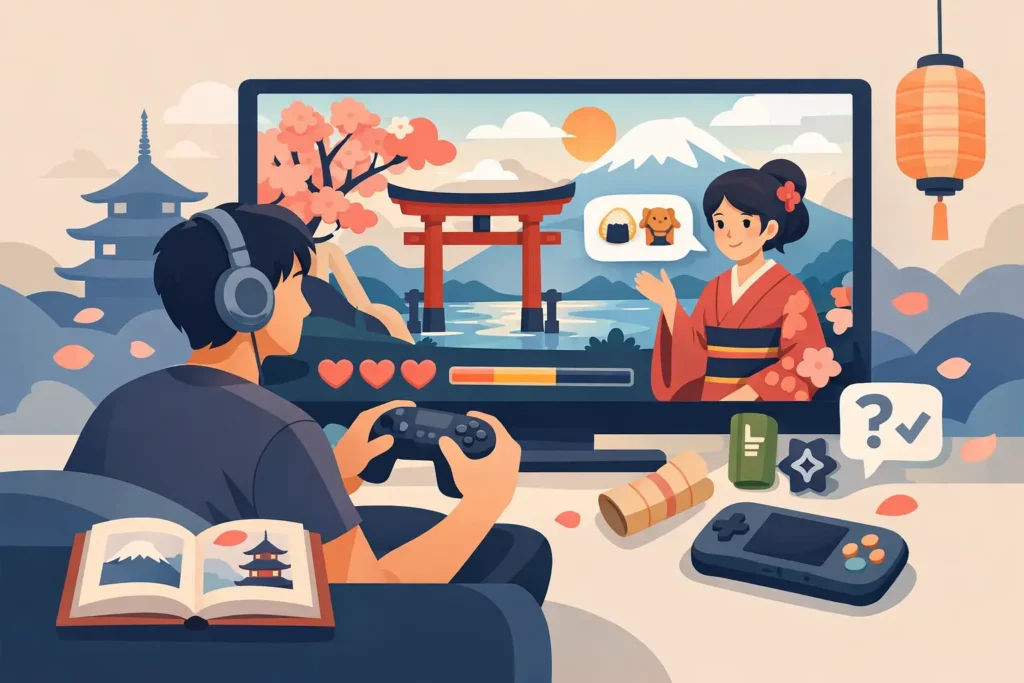
A Japanese word on a flashcard has one job: be remembered. A Japanese word that helps you spot an ambush, solve a puzzle, choose the right dialogue response, or protect a teammate has a job inside a story. That difference matters. When you learn Japanese through gameplay, language stops feeling like a stack of assignments and starts becoming useful information your brain wants to keep.
Games are not magic. Pressing buttons near Japanese text will not make anyone fluent. But well-designed gameplay can create something conventional study tools often miss: repeated, motivated encounters with language in a context that gives every word a purpose. For learners who would rather build a skill than maintain a streak, that is a serious advantage.
Why gameplay creates stronger Japanese practice
Japanese asks beginners to manage several challenges at once: new writing systems, unfamiliar word order, particles that shape meaning, and vocabulary that can feel abstract when it arrives in isolated lists. The hard part is not just seeing these elements. It is retrieving them fast enough to understand what is happening.
Gameplay turns retrieval into action. If recognizing みず means you can choose water instead of the wrong item, the answer has an immediate consequence. If reading 右 helps you take the correct path, kana and vocabulary become part of decision-making. A good game creates a loop: notice language, make a choice, receive feedback, try again. That loop is how recognition becomes recall.
The strongest learning games also use repetition without making repetition feel identical. A player may encounter the same word as a label, a clue, an ingredient, and a dialogue option. Each encounter reinforces the memory while asking the player to use it differently. This is more demanding than passive exposure, and that is exactly why it can be more durable.
There is a motivation advantage, too. Most learners do not quit because they hate Japanese. They quit because study sessions compete poorly with everything else demanding attention. Progress through a game provides visible goals, challenge, curiosity, and small wins. The learning is not a detour from play. It is part of how the player advances.
Learn Japanese through gameplay, not by accident
The phrase matters because not every game with Japanese dialogue is a learning tool. Importing a game from Japan can be motivating, especially for players already comfortable with the basics, but it can also overwhelm a beginner with unknown words, slang, and dense menus. Enjoyment alone is valuable. It is not the same as instructional design.
Purpose-built learning gameplay should make the language visible, usable, and recoverable. The player needs a reason to attend to a word, a chance to answer or act on it, and feedback that explains whether the choice worked. Ideally, the game also returns to the material later, after enough time has passed for real recall to be required.
That is where game design and learning science should meet. A timer can add urgency, but urgency without support only measures panic. A reward can make practice satisfying, but rewards cannot replace meaningful practice. The best systems balance challenge with clarity: players should feel stretched, not stranded.
Start with a playable language target
Before choosing a game or building a routine, decide what you want to be able to do. “Learn Japanese” is too broad to guide a session. “Read hiragana quickly,” “recognize food vocabulary,” “understand basic directions,” or “choose simple dialogue responses” gives you a target that gameplay can reinforce.
For early learners, prioritize hiragana and high-frequency vocabulary. Hiragana appears everywhere, and a small bank of useful words creates momentum quickly. Once those foundations are familiar, katakana, common verbs, adjectives, and sentence patterns become easier to connect to real situations.
For intermediate learners, the target can shift from recognition to comprehension. Look for games that ask you to infer meaning from context, distinguish similar phrases, or respond to a character with an appropriate sentence. At this stage, the most useful challenge is not simply seeing more Japanese. It is processing Japanese with less translation in your head.
What effective Japanese learning mechanics look like
A game earns its educational value through what players repeatedly do. The genre matters less than the mechanic. Puzzle games can be exceptional for kana and vocabulary because they encourage quick recognition. Role-playing systems can support dialogue, item words, and contextual phrases. Action games can build recall when language cues help players make decisions under pressure.
Look for four qualities in the experience:
- Meaningful choices: Japanese should affect what you do next, not sit in a decorative corner of the screen.
- Immediate feedback: Players need to know why an answer succeeded or failed while the moment is still fresh.
- Spaced returns: Words should reappear after a delay, in new situations, so memory has to do real work.
- Graduated difficulty: New language should build on familiar language instead of arriving as an unmarked wall of text.
A useful mechanic makes errors productive. Missing a word should not merely trigger a red X. It should reveal the correct answer, reconnect it to the situation, and create another chance to use it. Failure is part of the loop, not a reason to disengage.
This is also why random trivia is not enough. Answering a one-off question about a Japanese word may test memory, but it does not necessarily build a usable skill. Better design creates a system of connected decisions. The player begins to recognize patterns, anticipate meanings, and use what they have learned to solve new problems.
Build a routine that keeps the game honest
Gameplay works best when it has a clear role in a broader learning plan. Think of a game session as active practice, not as a substitute for every part of language learning. You still need listening exposure, opportunities to speak, and eventually longer reading. But a strong game can be the engine that makes daily vocabulary and script practice easier to sustain.
A practical routine can be simple. Play for 15 to 25 focused minutes, with one concrete target for the session. Maybe you are working on five direction words, a set of hiragana characters, or the difference between これ and それ. After playing, take two minutes to say or write a few words you remember without looking. That tiny recall check reveals whether you were learning or merely reacting.
If a word keeps appearing but will not stick, do not grind the same screen indefinitely. Change the input. Say it aloud, write it once, make a quick sentence, or attach it to something in your room. Games are powerful because they provide context and repetition. Adding a small personal connection can make the memory even stronger.
Track progress by capability rather than hours. Can you read a menu item you could not read last week? Can you recognize a phrase before the game translates it? Can you make a choice based on Japanese rather than guessing from icons? Those are meaningful level-ups.
The trade-offs: fun is necessary, but not sufficient
A learning game can be too educational in the wrong way. If every minute feels like a quiz wearing a costume, players will notice. The goal is not to hide study behind points. The goal is to design play where learning is genuinely useful to the experience.
The opposite problem is equally common. A game can be engaging but provide so little language interaction that the educational claim becomes decoration. A few Japanese labels, a pronunciation clip, or a themed character does not create a learning system. The question is straightforward: would the player make different, better decisions after learning the language in the game? If the answer is no, the language is probably not doing enough work.
It also depends on your level. Beginners benefit from clear scaffolding, controlled vocabulary, and frequent feedback. Advanced learners may prefer Japanese-first interfaces, more natural dialogue, and fewer interruptions. A game that is perfect for memorizing kana may be too limited for practicing nuanced conversation. There is no single best format, only a better fit for the skill you want next.
At Riot Shield Games, that fit is the mission: build games that leave players smarter than when they started. The standard is not “educational content added to a game.” It is gameplay designed so knowledge becomes a source of momentum, confidence, and real progress.
Make the next session count
Choose one Japanese skill you want to make more automatic this week. Then choose gameplay that forces you to use that skill repeatedly, gives you clear feedback, and remains fun enough to return to tomorrow. When the language helps you play better, every correct choice becomes more than a point on a screen. It becomes proof that you are building a skill you can carry beyond the game.