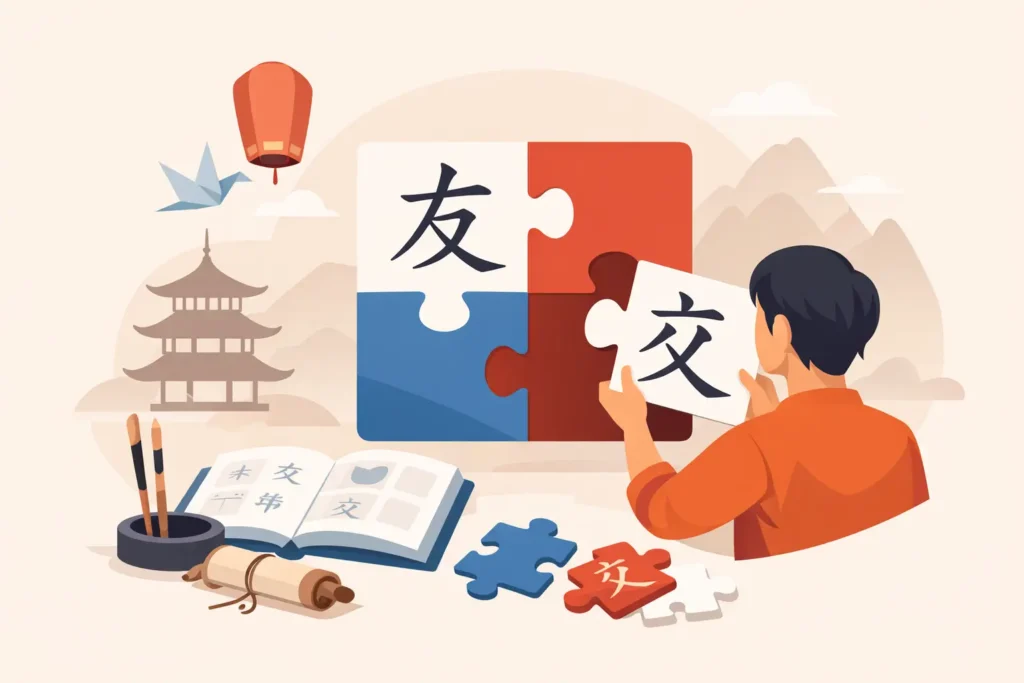
A Mandarin character can look like a wall of strokes until your brain has a reason to care. Then one well-timed match, missing-piece challenge, or rapid-fire recognition round turns that wall into a pattern you want to solve. To master Mandarin characters with puzzles, do not treat every hanzi as a picture to copy. Treat it as a system of clues waiting to be read.
That shift matters because Mandarin literacy is not built by looking at a character and hoping it sticks. It is built through repeated retrieval: seeing a form, recognizing its meaningful parts, connecting it to a sound and meaning, then finding it again under pressure. Good puzzles make that cycle feel like play instead of homework.
Why puzzles help Mandarin characters stick
Flashcards have a place. They are fast, portable, and useful for checking recall. But a stack of isolated cards can flatten Chinese into a long list of visual facts. The learner may recognize 我 or 学 in a familiar deck, then hesitate when those characters appear in a new word, sentence, or game board.
Puzzles add friction with purpose. A matching puzzle asks you to distinguish similar-looking forms. A build-the-character challenge requires you to notice components. A timed sorting round makes recognition faster. A clue-based puzzle connects visual structure to pronunciation or meaning. Each mechanic asks your memory to do something, not simply receive information.
That is the advantage of gameplay with instructional intent. A point score is not learning by itself. But when points reward accurate recall, smart pattern recognition, and returning to difficult characters, the game loop supports the skill you actually want: reading Mandarin with confidence.
Learn the pieces before chasing the whole character
Chinese characters are not random drawings. Many are built from recurring components, including radicals that often hint at meaning and phonetic elements that can offer a clue to pronunciation. These clues are not perfect shortcuts, but they reduce the feeling that every new character is an entirely new problem.
Take the water radical, 氵. When it appears in 河 (river), 海 (sea), or 洗 (wash), it gives you a meaningful category signal. You still need to learn each character, its pronunciation, and its use. But you are no longer memorizing three unrelated symbols.
Use component puzzles for visual logic
Start with puzzles that break characters apart and put them back together. If you see 休, recognize the person radical 亻 beside 木, tree. The traditional memory image of a person resting against a tree can help, but the deeper win is structural awareness. You are learning where components sit and how they form a stable character.
A useful progression is to begin with high-frequency characters that have clear components, then introduce variants and more visually dense forms. Do not wait until you know hundreds of characters to study radicals. Learn them as practical tools from day one.
Be careful with overconfident stories, though. Mnemonics are memorable, not always historically accurate. Use a vivid image to create a first foothold, then reinforce it with real words and repeated encounters. The goal is literacy, not winning a trivia contest about character origins.
Master Mandarin characters with puzzles that force recall
The best character puzzle is not necessarily the prettiest one. It is the one that makes you produce an answer before revealing it. Recognition feels good, but recall builds stronger access.
Imagine four puzzle types working together:
- Character-to-meaning matches train fast visual recognition, especially for common vocabulary.
- Component assembly puzzles teach radicals, layout, and stroke-level attention without turning practice into pure handwriting drills.
- Sound-and-character challenges connect hanzi to pinyin and tones, preventing the common trap of knowing what a character means but not how to say it.
- Sentence or phrase puzzles move characters out of isolation and into usable language.
These modes should not be treated as separate subjects. A character becomes more durable when its form, sound, meaning, and context reinforce one another. If you learn 吃 as “to eat,” then hear chī, build the character from its parts, and place it in 吃饭, you have created several routes back to the same answer.
Timed modes can sharpen recognition, but they are a trade-off. A countdown creates energy and exposes what you can retrieve quickly. It can also make beginners guess, panic, and learn sloppily. Use timed play after you have had untimed exposure. Speed is a second-stage skill, not the foundation.
Build a practice loop that feels like a game
You do not need a two-hour study marathon. You need enough meaningful repetitions to make characters familiar, with enough variety that you cannot solve every challenge by habit alone.
A strong 20-minute session can begin with five minutes of reviewing characters that caused trouble yesterday. Spend the next eight minutes on a focused puzzle set around one theme, such as food, school, family, or travel. Use the final minutes for mixed recall: characters from several earlier sessions, presented in new combinations.
The key is to keep a visible “boss list” of characters that repeatedly beat you. Maybe you confuse 请 and 清, or you know the meaning of 觉得 but lose the pronunciation. Those are not failures. They are useful data. Revisit them more often and in more than one puzzle mode.
This is where many study tools lose momentum. They treat a wrong answer as a red mark and move on. A better learning game treats it as a design signal: bring that character back later, change the clue, pair it with a contrasting character, and let the player earn the correction through another attempt.
Make confusion part of the challenge
Some of the hardest Mandarin characters are hard for a reason: they are visually similar, share a component, or belong to words that learners encounter before they fully understand them. Avoiding these collisions does not solve the problem. Contrast does.
Put confusing characters side by side. Ask what changed. Is it the radical? The right-hand component? The position of a stroke? For example, seeing 未 and 末 together makes the placement of one horizontal stroke suddenly matter. That tiny visual distinction is easier to remember after a puzzle has made it consequential.
Minimal-pair puzzles are especially useful once your character bank grows. They teach the eye to notice what casual exposure misses. They also make writing more accurate, because you begin to understand that character structure carries meaning rather than serving as decoration.
If handwriting is one of your goals, add it after recognition and assembly. Trace a model, then write from memory, then compare. Writing every new character dozens of times before you can recognize it is inefficient for many learners. Writing strategically, after you understand the character’s parts, makes each repetition count more.
Connect characters to words, not just answers
A single character often has multiple uses, and many everyday words contain two or more characters. Learning individual hanzi is essential, but it is only one layer of Mandarin. If a puzzle never moves beyond isolated answers, it can produce a strange kind of progress: a player who racks up points yet struggles to read ordinary phrases.
Use characters inside high-frequency words as early as possible. Learn 学 in 学生 (student) and 学习 (to study). Learn 人 in 中国人 (Chinese person) and 朋友 (friend) when relevant. The repeated character becomes a familiar teammate rather than a lone symbol.
Context also corrects false confidence. You may match a character to its most common English gloss, then discover that the real word behaves differently in a sentence. That is normal. Mandarin does not map one character at a time onto English. Puzzle-based practice should create the first connection, while phrases, audio, and reading build the richer understanding.
Play for progress, not empty streaks
A streak can get you back tomorrow. That is valuable. But a learning game should also show what the streak is accomplishing. Track characters recognized on first sight, characters recalled from meaning or sound, and recurring trouble spots. Progress feels more real when it is tied to a skill instead of a calendar.
Riot Shield Games builds around that principle: play should leave you smarter than when you started. For Mandarin learners, that means gameplay is not a distraction from study. When the mechanics demand attention, retrieval, and adaptation, gameplay becomes the study.
Set a small target that has teeth: recognize 15 new high-frequency characters this week, correctly rebuild five characters with familiar radicals, or read a short phrase set without checking pinyin first. Then let puzzles give you frequent shots at that target.
The next time a character looks impossible, do not stare harder. Break it apart, test yourself before the answer appears, meet it again in a word, and let one more round turn uncertainty into recognition. That is how symbols become language – one satisfying solve at a time.