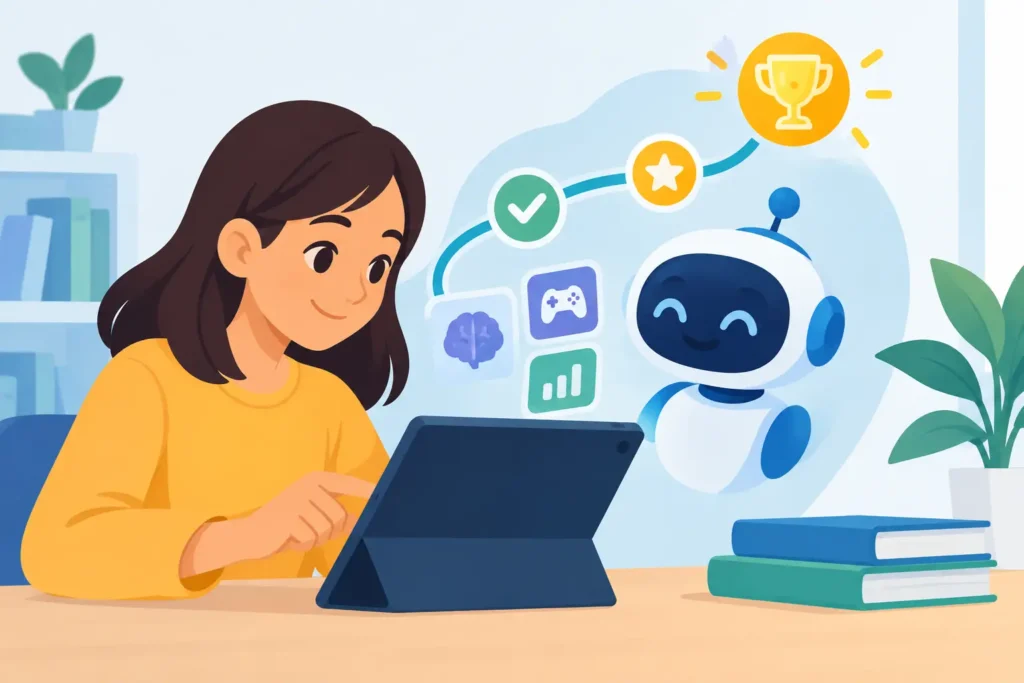
A vocabulary game knows you missed the same Japanese particle three times. A finance quest sees that you understand interest rates but freeze when risk enters the equation. Instead of dumping you into another generic lesson, it changes the next challenge. That is the real promise of AI in learning games: not a flashy chatbot pasted onto a quiz, but a game that pays attention to how each player learns.
For players who want more from their screen time, that matters. Practice should feel like progress inside a world worth returning to, not like homework wearing a health bar. Done well, AI can help games preserve the ingredient conventional study tools often lose: momentum.
AI in Learning Games Should Serve the Game
A learning game has two jobs. It has to teach something accurately, and it has to earn the player’s attention. If either half fails, the experience falls apart. A perfectly researched game that feels tedious will not get enough repeat play to build skill. A thrilling game with shallow educational mechanics may be entertaining, but it cannot honestly promise learning.
AI can strengthen the connection between those jobs. It can interpret player behavior, adjust what appears next, and create feedback that responds to the moment. The best use is not replacing designers, teachers, writers, or subject experts. It is giving them a more responsive system to work with.
Think of a language-learning puzzle game. A fixed sequence might present words in the same order to every player. That is simple to build and easy to assess, but it treats all mistakes as equal. An AI-supported system can recognize the difference between a player who needs more exposure to word order and one who knows the rule but is rushing through prompts. The first player may need a short pattern-based puzzle. The second may need higher stakes, faster decisions, or a challenge that rewards careful reading.
That distinction turns practice from repetition into purposeful play.
Personalization Is More Than Easier or Harder
When people hear personalization, they often imagine difficulty sliders. Those are useful, but they are only the beginning. A player’s ideal challenge changes by skill, topic, confidence, available time, and even the kind of mistake they are making.
AI can help a game tune several parts of the experience at once:
- The concepts a player needs to revisit before moving on
- The timing of review, so knowledge is recalled rather than merely recognized
- The type of prompt, such as a visual clue, dialogue choice, tactical decision, or construction puzzle
- The feedback style, from direct explanation to a hint that preserves discovery
- The pacing of missions, rewards, and optional side challenges
The key is preserving agency. If a game silently lowers the bar every time someone struggles, it can feel patronizing. If it relentlessly increases pressure, it becomes exhausting. Great adaptive design keeps the player in the zone where success feels earned and failure teaches something useful.
That is especially valuable in subjects people may already associate with anxiety. Personal finance, math, language speaking, and climate science can all trigger the fear of getting it wrong. A well-designed game gives players room to experiment. AI can make those experiments more targeted without making them feel watched or judged.
Feedback Can Become Part of the Fiction
The weakest educational feedback interrupts the game: wrong answer, red X, try again. It tells players that they missed something, but rarely helps them understand why.
AI creates room for feedback that fits the world. In an action RPG, a companion might notice that the player keeps confusing Mandarin measure words and offer a short in-world task where using the right phrase changes the outcome. In a climate-focused VR experience, an advisor could respond to the player’s policy choices by explaining the trade-offs they created, not just announcing a score.
This does not mean every character needs to become a chat window. Constant conversation can slow a game down, and open-ended AI dialogue can produce explanations that are vague, inaccurate, or inconsistent with the curriculum. Often, the smarter approach is bounded: expert-authored learning goals, carefully designed game states, and AI that selects or adapts the best response within those guardrails.
Players deserve feedback that is useful, clear, and grounded in the subject. Educational credibility is not optional just because the delivery system is fun.
The Risk: AI Can Make Bad Learning More Efficient
Not every AI feature improves a learning game. A system that generates endless questions may create volume without quality. A chatbot that confidently invents facts can damage trust. A personalization engine that optimizes only for session length may keep people playing while steering them away from meaningful challenge.
That last problem is worth taking seriously. Engagement and learning overlap, but they are not the same metric. A game can use streaks, rewards, and novelty to keep a player active without helping them retain or apply anything. The standard should be higher: can players demonstrate knowledge later, in a new situation, without the game handing them the answer?
Teams building AI-powered education should measure more than clicks and completion rates. They should look at recall, transfer, confidence, misconception correction, and whether learners voluntarily return because the game feels rewarding. They should test content with subject-matter experts and real players, especially the people the game claims to support.
Privacy matters too. Personalization requires data, and players should know what is being collected, why it is collected, and how it is protected. Young players and parents have every reason to expect transparency. The right system gathers only what it needs to improve the experience, gives users meaningful choices, and avoids treating learner data as a commodity.
Human Design Still Sets the Standard
AI is powerful at identifying patterns across many decisions. It is not automatically good at deciding what knowledge is worth teaching, what a player should feel after a difficult mission, or whether a mechanic respects the complexity of a real-world topic.
Those are human design decisions. They require curriculum expertise, playtesting, narrative judgment, accessibility thinking, and a clear point of view about what the game is trying to accomplish.
At Riot Shield Games, that principle is central: gameplay should not be a sugar coating on top of a lesson. The learning belongs in the mechanic itself. When players negotiate with limited resources, decode a language clue to advance, or weigh the consequences of a climate decision, the act of playing is also the act of practicing.
AI can make that loop more responsive. It can help identify the next meaningful obstacle, vary the context around a concept, and give players a path forward after failure. But it cannot substitute for a mechanic that makes the knowledge matter.
What Players Should Look For
As AI features show up in more educational products, players, parents, and educators should ask sharper questions. Does the game explain what the AI is doing? Are its lessons tied to a credible curriculum? Does adaptation make challenges more meaningful, or does it simply make them easier? Can the player see tangible progress in a skill, not only in badges or points?
It also depends on the subject. Open-ended language conversation may benefit from flexible AI interaction, provided it is checked for accuracy and safety. A game teaching foundational math may need tighter constraints, where every response maps to a known misconception and a validated explanation. Climate and finance simulations may benefit from AI-generated scenarios, but only if the underlying models and assumptions are transparent.
The most exciting future is not one where AI takes over learning games. It is one where it helps small, ambitious teams build experiences that notice more, teach better, and respect players enough to challenge them.
The next time a game asks you to make a choice, solve a puzzle, or take one more turn, the question is not whether AI is behind it. The question is whether that moment leaves you more capable than you were five minutes ago. That is the level worth playing for.