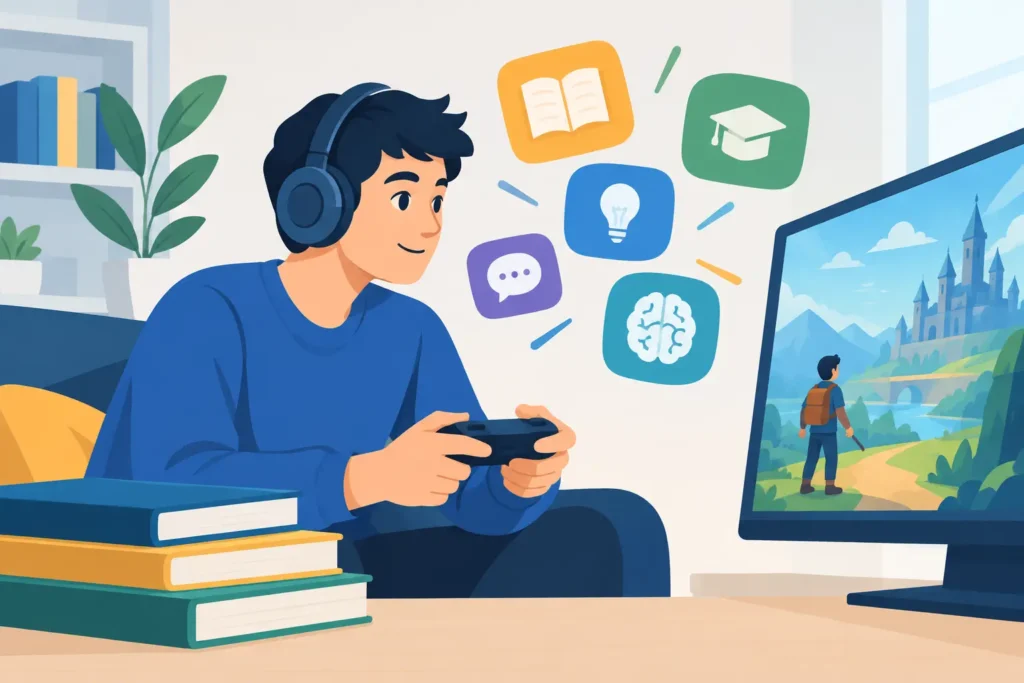
A player pauses before choosing a dialogue option. One word in the sentence is unfamiliar, but the character’s expression, the mission objective, and the possible responses make its meaning clear. Minutes later, that same word appears during a puzzle. Then again in a new conversation. That is the moment vocabulary stops being a definition on a card and starts becoming usable knowledge.
So, do games improve vocabulary? They can, often remarkably well. But the answer is not that every game automatically teaches language. A game full of text can still leave players skimming menus, skipping dialogue, or memorizing nothing. Vocabulary grows when gameplay gives words meaning, requires attention, and brings them back at the right time.
For learners who are tired of treating language as a stack of isolated flashcards, that distinction matters. Great educational games do not disguise a worksheet with bright colors. They use the strengths of games – choice, challenge, feedback, and repetition – to make learning part of the reason players want one more turn.
Do Games Improve Vocabulary Better Than Study Alone?
Games are not a replacement for every form of study. Direct instruction can explain grammar quickly, dictionaries can clarify a precise definition, and spaced-repetition tools are efficient for reviewing large word lists. The problem is that knowing a word’s translation is not the same as recognizing it in motion, understanding its tone, or retrieving it when you need it.
Games can close that gap because they create context. A word connected to a character, an objective, a consequence, or a surprise has more mental hooks than a word learned in isolation. If a player sees a Japanese term while negotiating with an NPC, solving a clue, and choosing an item, the word becomes attached to a situation rather than a single English equivalent.
That connection is especially valuable for verbs, descriptive language, and words with multiple meanings. A learner may memorize that a word means “run,” for example, but a game can show whether it means sprint, operate, escape, manage, or flow. Context does not just make vocabulary more memorable. It makes vocabulary more accurate.
The advantage also depends on attention. Passive exposure helps, but active decisions help more. Reading a word in a cutscene is useful. Choosing the right response under pressure, matching a word to an object, or using it to progress through a mission demands retrieval. Retrieval is the hard part of learning, and it is where durable memory gets built.
Why Some Games Build Vocabulary and Others Do Not
A commercially successful game may expose players to thousands of words without teaching many of them. That is not a failure of games as a medium. It is a design issue.
Players learn more when language is tied to a meaningful action. If the correct word opens a route, helps a teammate, reveals a clue, or changes a story outcome, it has a job to do. The player is no longer reading because the game told them to read. They are reading because they want to win, explore, or see what happens next.
A strong learning loop also revisits words across different situations. Seeing a new term once may create familiarity. Seeing it again after a short delay, then using it in a slightly different context, strengthens recall. The best systems avoid both extremes: endless drilling that feels like homework and one-off exposure that disappears before it can stick.
Feedback matters, too. A wrong answer should not merely trigger a red X. It should clarify why the choice did not fit, make the correct meaning visible, and give the player another opportunity to use it. In a well-designed game, failure is information. That is one reason games can be powerful learning environments: they normalize trying, missing, adjusting, and trying again.
The difference between exposure and learning
Exposure is seeing the word cautious in dialogue. Learning begins when the player understands why a cautious character refuses a risky plan. Retention improves when the player later has to choose cautious rather than reckless to guide that character through a challenge.
This is why a game’s word count is not a useful measure by itself. A massive script can create lots of exposure. A smaller, carefully structured vocabulary system can create more learning if it repeatedly asks players to notice meaning and retrieve it.
What Vocabulary-Focused Game Design Looks Like
Educational value should not come at the expense of momentum. A game that interrupts every 30 seconds for a lecture will train players to avoid learning moments. The better approach is to make language part of the game’s core loop.
A puzzle game can ask players to identify patterns in characters or word components. An action RPG can place language inside quests, item systems, dialogue choices, and tactical decisions. A social or narrative game can teach register and tone by showing how a phrase changes depending on who is speaking and what is at stake.
The most effective vocabulary design usually includes four connected elements:
- Clear context, so players can infer what a new word means before being told.
- Useful repetition, so words return across levels, challenges, and story beats.
- Active recall, so players select, produce, or apply language rather than only recognize it.
- Immediate feedback, so mistakes become productive rather than frustrating.
These elements work because they respect the player. They do not assume people need to be tricked into learning. They assume people enjoy getting better when progress is visible and the challenge feels worth overcoming.
That philosophy is central to Riot Shield Games: build experiences with real gameplay stakes and real instructional intent. A language mechanic should feel like a mechanic, not a pop quiz bolted onto the side of one.
How Players Can Get More Vocabulary From Games
The game matters, but so does how you play it. If your goal is vocabulary growth, choose games that present language in manageable doses and give you a reason to return to it. Dialogue-heavy games can be useful, but only if you slow down enough to notice recurring words rather than treating every text box as an obstacle.
Set one modest objective for a session. You might decide to notice five new words, follow one recurring phrase, or replay a scene after checking your understanding. That is more sustainable than trying to collect every unfamiliar term. Vocabulary is not a scavenger hunt for obscure words. It is the gradual construction of a working language system.
When a word seems important, pause briefly and predict its meaning from context before checking it. That small act of prediction makes the correction more memorable. If the game lets you revisit dialogue, inventory descriptions, or mission text, use those features as natural review instead of switching immediately to a separate study app.
For language learners, it can also help to play a familiar game in the language you are studying. Familiar mechanics reduce cognitive load, leaving more attention for words and phrases. However, beginners should be realistic: a fast, text-dense RPG entirely in a new language may be more exhausting than educational at first. Start with material that is challenging enough to demand focus but understandable enough to stay fun.
The Trade-Off: Fun Is Necessary, but It Is Not Enough
There is a temptation to claim that anything enjoyable must be educational. That is too simple. Fun helps because it increases time on task and makes repetition easier to tolerate. But entertainment alone does not guarantee comprehension, transfer, or long-term recall.
Likewise, a highly structured learning game can miss the mark if it strips away autonomy and surprise. Players need room to experiment. They need satisfying goals that are bigger than “get the answer right.” The design challenge is not to choose between learning and play. It is to make each one strengthen the other.
For parents and educators, this means looking beyond labels like “educational.” Ask whether the game asks players to use knowledge, whether it provides meaningful feedback, and whether the content returns over time. For players, ask a simpler question: after an hour, can I understand or use something I could not before?
The right game will not make every word effortless. It will make the effort feel earned. Find experiences that ask you to notice, decide, fail safely, and try again – then let your next level be a little smarter than the last.