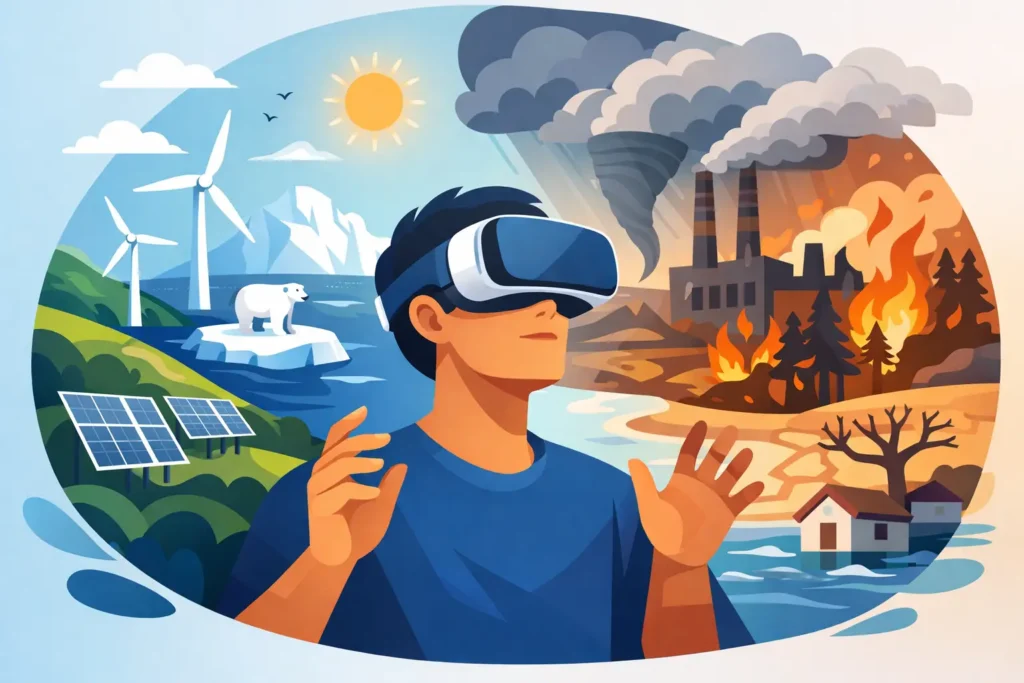
A graph can show a warming trend. VR can put you inside a forest as it disappears, on ice as it melts beneath your feet, or in a future shaped by rising seas. That is why the best climate change VR experiences matter: they turn a problem that often feels enormous and abstract into something players can see, feel, question, and remember.
For curious gamers, students, and educators, the strongest experiences do more than deliver a sobering spectacle. They connect scientific evidence to human stakes, give the viewer a role inside the scene, and leave room for reflection rather than treating fear as the final mechanic. Some are built for headsets at home; others began as museum, classroom, or festival installations. Availability can change, but each is worth seeking out for what it teaches about climate storytelling.
What Makes Climate VR Worth Playing?
Climate communication has a distance problem. A one-degree shift in global temperature is consequential, but it does not sound dramatic in the way a monster attack or a final boss does. Its effects are distributed across places, species, and decades. VR narrows that distance by giving scale, place, and perspective to systems that otherwise live in reports.
But immersion alone is not education. A beautiful 360-degree video can create empathy, yet it may not help someone understand causes, trade-offs, or what to do next. The best work pairs presence with context. It lets players witness an outcome while giving them enough scientific framing to connect that outcome to choices about energy, land, food, consumption, or policy.
That distinction matters for anyone who wants their screen time to have substance. A powerful climate VR experience should not feel like a lecture wearing a headset. It should use the medium’s strengths – spatial learning, embodiment, discovery, and consequence – to make learning part of the experience.
5 Best Climate Change VR Experiences for Deeper Learning
Tree
Tree begins with an unusually direct idea: instead of observing a rainforest, you become part of one. Players inhabit a seedling that grows into a towering kapok tree, using hand and body movement to experience the forest from the inside. The experience then confronts you with deforestation.
Its power comes from embodiment. Seeing a tree cut down can be sad; feeling as though your own body is rooted in the ground changes the emotional logic. Tree is especially effective for younger learners and first-time VR users because its central metaphor is immediately understandable. It also opens useful conversations about carbon storage, habitat loss, Indigenous stewardship, and the gap between knowing forests matter and feeling why they matter.
The trade-off is that Tree is more emotional than systems-heavy. It creates a memorable entry point, not a complete lesson on land-use economics or climate policy. Use it to start the conversation, then build on it with evidence and discussion.
This Is Climate Change
This Is Climate Change is a documentary series that moves through multiple climate pressures, including melting ice, wildfire, and the environmental cost of industrial agriculture. Rather than presenting climate change as one distant disaster, it shows a connected set of realities with local consequences.
That breadth is its biggest strength. A player can see that climate change is not only about polar bears or future coastlines. It intersects with food systems, communities, public health, migration, and ecosystems. For college students and adult learners, the episodic structure makes it easier to compare causes and consequences across regions.
It is primarily an observational experience, so agency is limited. You are there to witness, not to alter the outcome. Still, that can be the right design choice when the goal is to center people already living through the consequences rather than turning their hardship into a game mechanic.
Greenland Melting
Greenland Melting puts players alongside scientists studying the Greenland Ice Sheet, bringing field research into an environment that most people will never encounter directly. Instead of treating ice loss as a vague symbol of warming, it shows how scientists observe, measure, and interpret a changing landscape.
This is one of the best choices for learners who want climate literacy, not only emotional impact. The experience reinforces an essential point: climate science is not a collection of guesses from a screen. It is built through observation, measurement, modeling, peer review, and persistent work in difficult conditions.
Its narrower focus is also its limitation. If someone needs an introduction to climate change as a whole, begin with a broader experience. If they want to understand why ice sheets matter for sea-level rise and why scientific process deserves trust, Greenland Melting is a strong fit.
The Stanford Ocean Acidification Experience
The Stanford Ocean Acidification Experience uses embodied perspective to make ocean chemistry tangible. Participants encounter the consequences of increasing carbon dioxide in the ocean and the pressure it places on marine ecosystems, particularly organisms that rely on calcium carbonate structures.
Ocean acidification is often overshadowed by temperature and sea-level rise, partly because it is harder to picture. This experience tackles that problem well. It translates an invisible chemical shift into a spatial, biological story. For STEM-minded players, that is a smart example of how VR can make complex processes easier to grasp without reducing them to trivia.
This type of academic VR may be harder to access than consumer entertainment, and some versions have been designed for research or educational settings. That is worth the effort when available. It demonstrates the standard climate learning experiences should aim for: compelling enough to remember, grounded enough to teach accurately.
The Key
The Key is not a conventional climate explainer, but it earns a place in this conversation because it explores displacement, memory, and the emotional cost of losing home. Its dreamlike structure avoids a checklist of facts and instead asks players to inhabit uncertainty and separation.
Climate change is already amplifying displacement risks through floods, droughts, storms, and resource insecurity. The Key should not be presented as a one-to-one simulation of every displaced person’s experience. No short VR piece can carry that burden. What it can do is help players approach the human side of climate migration with more humility.
For classrooms, pair it with real-world reporting, regional climate data, and a discussion about language. Terms such as climate refugee can simplify legal and political realities. Good learning does not stop at empathy. It tests empathy against facts.
How to Choose the Right Climate VR Experience
Pick based on the question you want the experience to answer. Tree works when the goal is to build emotional connection with ecosystems. Greenland Melting works when learners need to understand how climate evidence is gathered. The Stanford Ocean Acidification Experience fits a science lesson about carbon cycles and marine ecosystems. This Is Climate Change is the better starting point for a broad conversation about interconnected impacts.
Headset access also matters. A high-end installation can be unforgettable, but a short 360-degree experience viewed in an accessible headset may reach more people. For educators, the best option is often the one that can be followed by discussion, a hands-on activity, or a learner-created response. The headset is not the lesson plan. It is the spark.
Age and emotional readiness matter too. Wildfire, displacement, and ecological loss can be intense. Give players context before they enter, and give them space to process afterward. A strong debrief can ask what they noticed, what surprised them, what evidence they would want next, and what actions belong to individuals versus institutions.
The Next Level Is Agency
The future of climate VR should move beyond passive witnessing without pretending that a player can solve a planetary crisis in ten minutes. The most promising experiences will let players explore trade-offs, test systems, collaborate, and see how choices ripple through communities. They will make room for uncertainty while remaining faithful to science.
That is the design challenge Riot Shield Games cares about: build play that is genuinely fun, then make the learning inseparable from the fun. Climate literacy should not feel like homework assigned after the game ends. It should be part of the challenge, the curiosity, and the reward.
Play one of these experiences with your questions switched on. Notice what it makes visible, what it leaves out, and what it asks you to feel. The most valuable virtual worlds do not let us escape reality. They help us return to it more prepared to act.