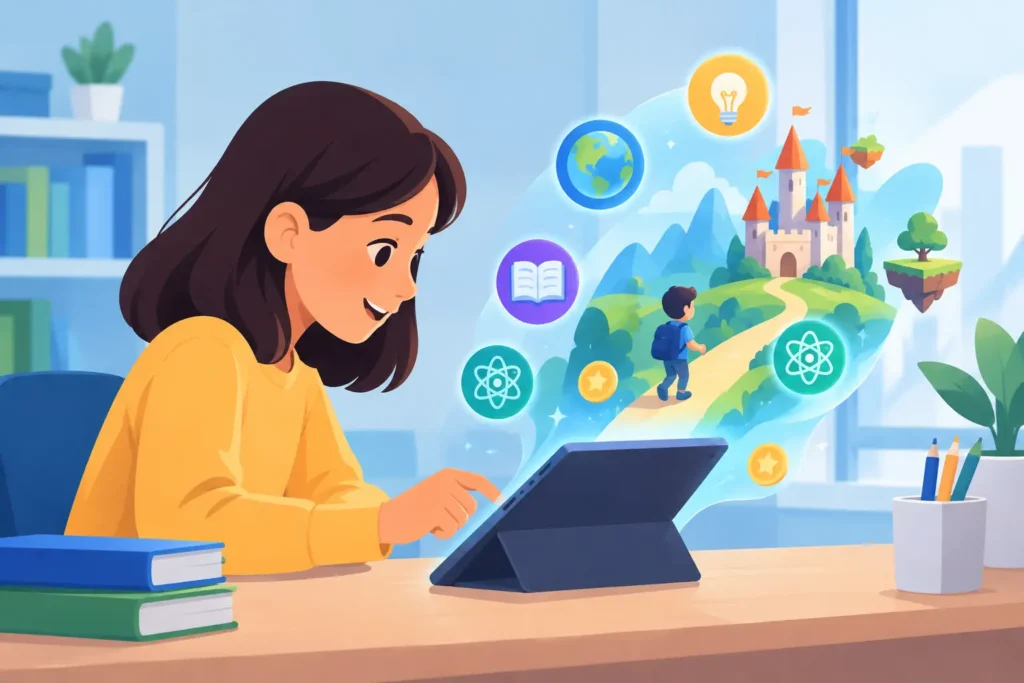
A player clears a puzzle room by recognizing Japanese characters before the timer runs out. Another manages a struggling virtual city and learns why a budget can collapse. A third steps into a flooded coastline in VR and sees climate systems as a lived reality, not a chapter to memorize. That is the future of educational gaming: learning that does not pause the fun, interrupt the story, or ask players to tolerate a game for the sake of a lesson.
For too long, the category has been split in two. Games were expected to entertain. Educational software was expected to instruct. One got the energy, polish, and cultural relevance. The other got worksheets with sound effects. That split is finally becoming obsolete.
The next generation of learning games will not win because they call themselves educational. It will win because players want to keep playing – and become more capable because they do.
The future of educational gaming raises the bar
Calling something a game does not make it engaging, and adding trivia to an existing game loop does not create meaningful learning. Players know the difference. If the quiz is merely standing between them and the interesting part, they will either disengage or learn to click through it without thinking.
Great educational gaming begins with a tougher design question: what can the player do only by understanding the subject? In a well-designed language game, vocabulary is not a separate test after the action. It is part of the action. A player might need to read a clue, negotiate with a character, recognize a symbol, or choose the right phrase under pressure. Progress comes from comprehension, not from pretending comprehension happened.
This is a higher standard than gamification. Points, streaks, badges, and leaderboards can encourage repetition, especially at the beginning. But they are external rewards. They do not automatically make a skill interesting. Intrinsic motivation appears when learning changes what the player can perceive, decide, build, or overcome inside the game.
That distinction matters. A streak may bring someone back tomorrow. A satisfying system gives them a reason to care when they arrive.
Learning must be part of the core loop
The strongest educational games will build knowledge directly into their verbs. If the core verbs are explore, compare, infer, experiment, communicate, and strategize, the game can teach players to think rather than simply recall.
Consider personal finance. A shallow game might ask players to identify the definition of compound interest. A better game gives them limited resources, competing goals, unexpected setbacks, and a long-term consequence for every short-term choice. The player feels why an emergency fund matters because the game world creates the same pressure real life does. The concept becomes usable.
STEM works the same way. Players do not need a pop-up explaining that systems have feedback loops if they can observe one, intervene in it, make a prediction, and watch the outcome unfold. Climate literacy becomes more powerful when players see how energy, infrastructure, policy, and individual behavior interact rather than receiving a sequence of facts about carbon emissions.
This approach has a trade-off. A game that faithfully models a subject can become too complex for newcomers. A game that simplifies everything may teach an incorrect mental model. The answer is not to choose between fun and rigor. It is to sequence complexity well: start with an intuitive challenge, reveal the system through play, then give players room to test deeper strategies once they are ready.
The lesson cannot feel bolted on
Players will forgive failure when it teaches them something useful. They will not forgive busywork.
That means instructional design has to work alongside game design from the earliest concept stage. Curriculum experts can identify the misconceptions learners commonly carry. Designers can turn those misconceptions into meaningful decisions, surprising consequences, and moments of discovery. Writers can give the knowledge a human reason to matter. When these disciplines meet early, the result feels like one experience instead of a game with school taped to the side.
AI can personalize the path, not replace the design
Artificial intelligence will influence educational gaming, but not in the way the loudest predictions suggest. The exciting use is not an AI character that talks endlessly. It is a learning system that recognizes patterns in how a player struggles and responds intelligently.
A language learner may understand words in isolation but freeze when they appear in a sentence. A finance learner may make sound choices in calm conditions but panic when the game introduces uncertainty. Adaptive systems can identify these gaps and adjust the next challenge, offering practice that is relevant without making the player feel singled out or trapped in remedial mode.
Used well, personalization protects momentum. It can provide a harder puzzle for a player who is ready to advance, a contextual hint for someone stuck, or a fresh scenario that tests whether a skill transfers beyond the original lesson.
Used poorly, it creates an opaque machine that feeds players more content without a clear learning purpose. Educational games should be transparent about what they collect, why they collect it, and how it shapes the experience. Especially for younger players, privacy and safety are design requirements, not fine print.
AI also cannot rescue a weak game loop. A generic task delivered with exquisite personalization is still generic. Human creativity, strong mechanics, and academically sound goals remain the foundation.
Assessment should feel like evidence, not surveillance
Players, parents, and educators all want proof that learning occurred. The mistake is treating assessment as a separate exam waiting at the end of the level.
Games already generate evidence through choices. Which clues did a player use? Which concepts did they apply under pressure? Did they succeed only after repeated trial and error, or did they demonstrate a strategy that works in a new context? These signals can reveal far more than a multiple-choice score.
The future of educational gaming will make that evidence useful. Players should see their growth in language fluency, scientific reasoning, financial decision-making, or systems thinking. Educators should be able to understand progress without needing to become data analysts. Parents should receive a clear picture of skill development, not a meaningless report that says their child spent 43 minutes in an app.
Measurable learning matters, but measurement must serve the player. If every click feels monitored, curiosity disappears. The best systems show progress as another source of agency: you can see what you know, where you are improving, and what challenge is worth taking on next.
Serious games need real production values
The old excuse for mediocre educational experiences was that the subject mattered more than the presentation. That argument has expired. Players compare every game to the best experiences available on their phone, console, PC, and headset. They notice weak feedback, cluttered interfaces, flat writing, repetitive loops, and art that feels like an afterthought.
Educational games do not need blockbuster budgets to compete. They do need intention. A memorable visual identity, responsive controls, strong sound design, and writing with personality tell players that their time is valued. These elements also support learning. Clear feedback helps players understand cause and effect. A compelling world creates context for new information. Good pacing gives the brain time to form connections before the next challenge arrives.
This is where independent studios have an advantage. They can take a focused learning goal and build a distinctive experience around it instead of forcing it into a one-size-fits-all platform. Riot Shield Games operates from that belief: play can carry serious intellectual weight without becoming a lecture.
The audience is bigger than the classroom
The most interesting shift is cultural. Educational gaming is no longer only for children, schools, or people trying to pass a test. Adults want screen time that gives something back. College students want study tools that do more than repeat flashcards. Language learners want practice they can sustain beyond the first burst of motivation. Families want games they can feel good about sharing.
That does not mean every game must advertise itself as self-improvement. Play deserves to be playful. But the market is growing for experiences that respect both a player’s curiosity and their time. A game can be adventurous, strange, funny, challenging, and genuinely useful all at once.
The winners will be studios willing to reject the false choice at the center of the category. Learning does not have to be dry to be credible. Gameplay does not have to be empty to be entertaining.
The next time you choose a game, ask a sharper question than whether it is educational: what will this game teach me to notice, understand, or do better? The answer may be the most exciting part of the experience.