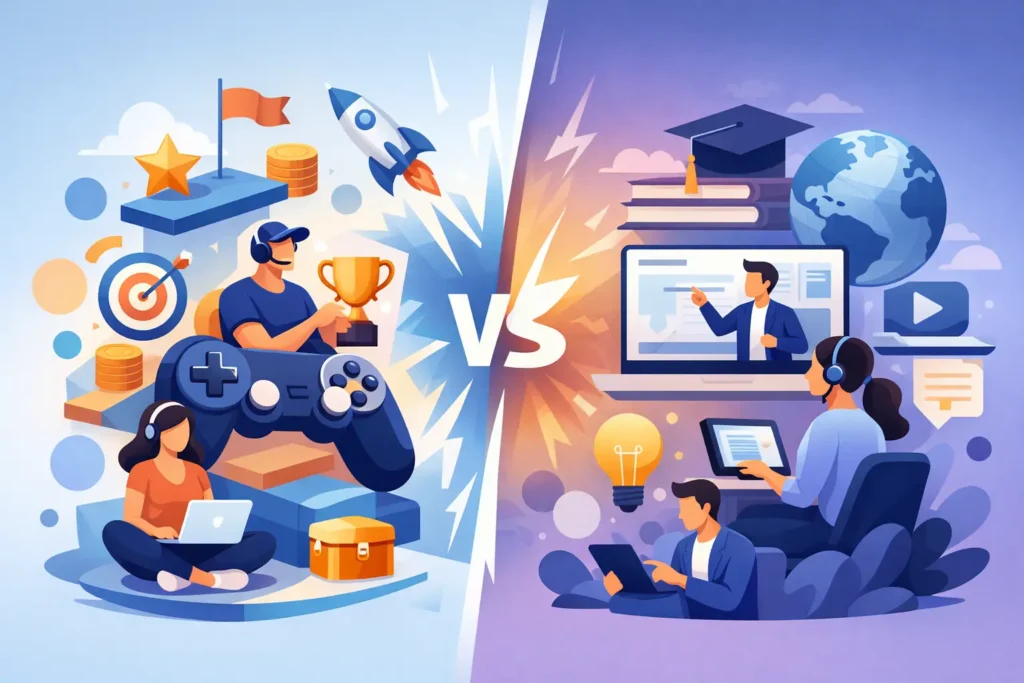
A progress bar can make a compliance course feel less bleak. It cannot, by itself, make someone care about cybersecurity, Japanese vocabulary, or compound interest. That is the real tension in gamification versus e-learning: are we decorating traditional instruction with game-like rewards, or designing experiences where learning happens because the player wants to keep playing?
For learners who have spent years clicking through slides, memorizing flashcards, and forgetting half of them by Friday, the distinction matters. Screen time is not automatically wasted, but it should earn its place. A great learning experience should leave you with more than points, badges, and a completed module. It should leave you smarter, more capable, and ready to use what you learned.
Gamification Versus E-Learning Is the Wrong Fight
E-learning is a delivery format. It can include video lessons, interactive quizzes, simulations, reading, virtual classrooms, and self-paced courses. Its strength is reach: a learner can study a new language, technical skill, or academic subject from almost anywhere, often on their own schedule.
Gamification is a design approach. It borrows elements commonly found in games – points, levels, streaks, challenges, leaderboards, rewards, and feedback loops – to increase participation in a non-game activity. It can be added to an e-learning course, a fitness app, workplace training, or nearly any task that people tend to avoid.
That means gamification and e-learning are not natural enemies. Gamification can improve e-learning. But it can also expose a weak course. If the lesson is passive, vague, or irrelevant, adding coins and confetti may produce a short burst of activity without producing understanding.
The more useful question is this: what kind of interaction does the learner need to build a real skill?
The Difference Between a Reward Layer and a Game
A reward layer sits on top of an existing learning activity. Watch a video, answer five questions, earn a badge. This can work well when the underlying task is already valuable but needs clearer momentum. A weekly streak may help someone return to language practice. Immediate feedback can help a student see that they are improving. A visible path through a course can make a large goal feel manageable.
A learning game goes further. The core actions of play are also the actions of learning. If a player must recognize vocabulary to solve a puzzle, use financial reasoning to make strategic choices, or apply a scientific concept to overcome an obstacle, the curriculum is not an interruption between gameplay loops. It is part of the loop.
This is where many products miss the mark. They ask players to stop having fun in order to learn, then offer a reward for enduring the interruption. Strong educational game design flips that relationship. Learning becomes the tool that makes the player more effective, more curious, and more likely to succeed.
At Riot Shield Games, that principle shapes the work: build games that leave players smarter than when they started. The standard is not whether a game contains educational content. The standard is whether the content has a meaningful job inside the game.
Why Points Alone Rarely Create Lasting Motivation
Extrinsic rewards are not bad. They are simply limited. Points can signal progress. Unlocks can encourage practice. A leaderboard can energize a competitive group. The trouble starts when the reward becomes more compelling than the skill itself.
Consider a language learner who races through easy exercises to preserve a streak. They may log in every day yet avoid speaking, listening closely, or recalling words without prompts. The app records engagement, but engagement is not mastery. A learner can be highly active and still be building a fragile understanding.
Lasting motivation usually grows from three experiences: competence, autonomy, and purpose. People return when they can feel themselves getting better, make meaningful choices, and understand why the effort matters. Good games are exceptionally good at creating these conditions. Players experiment, fail safely, adapt their strategy, and see the consequences of better decisions.
That does not mean every subject needs an action RPG or a virtual reality world. Sometimes a direct lesson is the fastest way to explain a formula, introduce a historical context, or demonstrate pronunciation. The best format depends on the learning goal. But when a learner needs repeated practice, judgment, recall under pressure, or a reason to persist through difficulty, game design has unusual power.
When Traditional E-Learning Is the Better Tool
There are moments when games would add friction rather than value. An employee who needs an updated policy by the end of the day may benefit more from a short, searchable module than a quest. A college student preparing for an exam may need a concise explanation before they are ready to apply a concept. A detailed safety procedure should be clear before it becomes creative.
Traditional e-learning also excels at organization. It can present a structured sequence, house reference materials, track completion, and give learners access to an expert explanation at the exact moment they need it. Its weakness is often passivity, not legitimacy.
The smartest learning systems use the right tool for the job. They explain when explanation is needed, test when retrieval matters, and create play when active application will deepen the lesson. A well-designed experience might pair a short instructional moment with a challenge that requires learners to use the concept, not merely recognize it on a multiple-choice screen.
What Meaningful Learning Through Play Looks Like
A game becomes educationally valuable when its mechanics create useful cognitive work. That work can take different forms, but it should be visible in what the player does repeatedly.
In language learning, meaningful play might require players to identify words in context, infer meaning from clues, listen for distinctions, and retrieve vocabulary quickly enough to make a choice. In STEM, it might mean modeling a system, testing a hypothesis, interpreting patterns, or managing limited resources. In personal finance, it could mean weighing trade-offs between risk, time, spending, and long-term goals.
The best feedback is also specific. “Correct” is helpful, but it is not enough. Players need feedback that reveals why a decision worked, what changed as a result, and what they can try next time. Games naturally support this through consequences. Choose the wrong tool, and a puzzle stays locked. Misread a signal, and the strategy fails. Learn the system, and new possibilities open.
That feedback loop makes failure useful rather than embarrassing. In a good game, failure is information. You do not simply receive a low score and move on. You adjust, replay, and improve. For subjects that feel intimidating in school, that shift can be transformative.
How to Judge a Gamified Learning Product
Do not be impressed by game terminology alone. Ask whether the product makes the learner practice the skill that matters. If the answer is no, the game elements may be motivating, but they are not doing the teaching.
Look for a clear connection between player actions and learning outcomes. Is the learner making choices with the target knowledge? Does the challenge become more sophisticated as they improve? Can they explain, recall, or apply what they learned away from the screen? Does the experience respect their intelligence instead of reducing education to a slot machine of tiny rewards?
It is also worth asking whether the game is genuinely fun. Educational value and entertainment do not cancel each other out. A game with serious instructional intent still needs compelling goals, responsive controls, satisfying feedback, strong pacing, and challenges worth overcoming. If the gameplay is thin, learners will feel the lesson hiding underneath it. If the learning is thin, players will eventually realize the rewards are hollow.
The Better Standard: Play That Builds Capability
The future is not a choice between traditional courses and colorful badges. It is a higher standard for both. E-learning should respect attention and give learners active ways to test understanding. Gamification should support meaningful effort rather than distract from it. And educational games should be judged as games and as learning systems, because players deserve both.
For anyone choosing how to spend an hour online, that standard is refreshingly simple: choose experiences that make you want to continue, then give you a reason to be proud you did. Play. Learn. Level up.