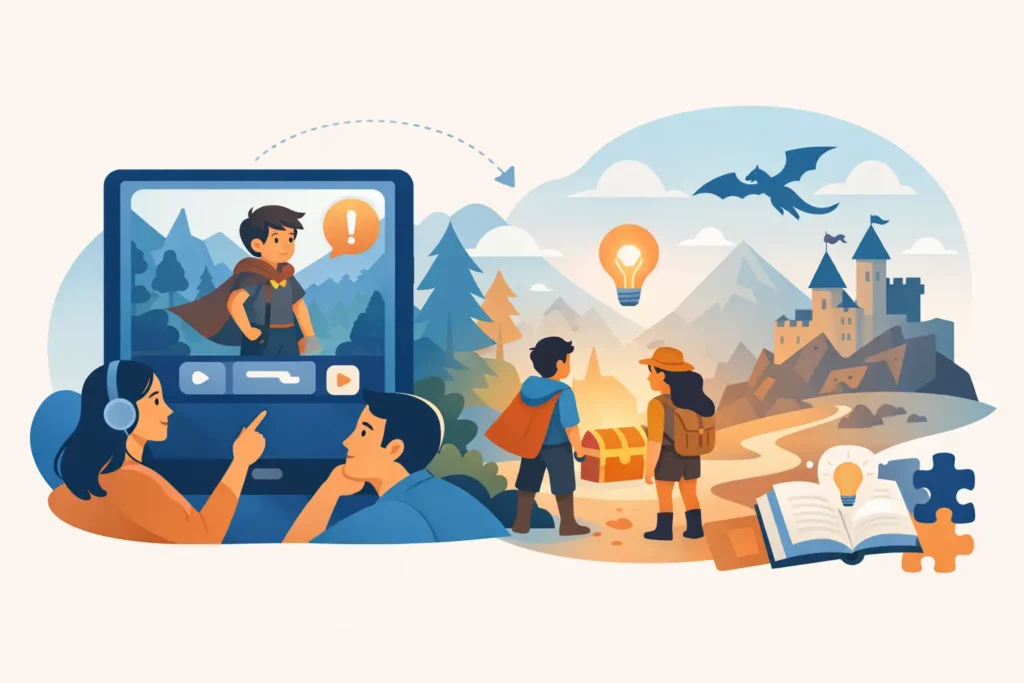
A vocabulary word appears in the middle of a dungeon run. A budgeting decision determines whether your crew can upgrade their ship. A climate system changes because you chose the fast, cheap solution instead of the durable one. That is where story driven learning games earn their place: not by disguising a worksheet with points, but by making knowledge matter to the player.
The difference is bigger than it sounds. Plenty of games add trivia questions, flashcards, or a thin educational wrapper. Players may earn rewards, but the learning sits outside the real game. A story-driven learning game ties the lesson to the stakes, choices, systems, and progress of play. You do not pause the adventure to study. You learn because understanding the subject helps you move forward.
For gamers who want more from their screen time, that is a serious design standard. For educators and parents, it is the difference between a product that gets downloaded and a product that gets played long enough to make a difference.
What Makes Story Driven Learning Games Work
Narrative gives information a reason to exist. A new Japanese phrase is more memorable when it helps you understand a character’s warning, negotiate with a rival, or solve the next puzzle. A lesson in compound interest becomes more concrete when it affects the resources available to your party across an entire campaign.
This is not magic. Stories do not automatically create learning. The subject matter still needs to be accurate, carefully sequenced, and practiced often enough for players to retain it. But narrative creates a powerful answer to the question that every learner eventually asks: Why should I care?
In a well-designed game, the answer is immediate. You should care because the world responds to what you know. The language is not decorative. The science is not a pop quiz. The financial concept is not an isolated formula. It is part of your strategy.
That shift changes motivation. Traditional study often asks learners to tolerate effort now for a possible benefit later. Games can make effort rewarding in the moment. Curiosity pulls the player toward the next scene, the next challenge, or the next discovery. Progress feels earned, not assigned.
Agency turns knowledge into action
The strongest learning experiences ask players to make decisions, not simply recognize correct answers. Recognition has value, especially for early vocabulary practice. Yet knowing that an answer looks familiar is different from using it under pressure.
Agency creates productive pressure. If a player must choose how to respond in a conversation, allocate limited resources, or predict the outcome of a scientific system, they have to retrieve and apply what they know. A wrong choice can become feedback rather than failure. The game shows a consequence, invites another attempt, and keeps the player in the loop.
That loop matters because it makes learning active. Players are not passive viewers of an educational story. They are participants whose growing knowledge changes what they can do.
Repetition needs variation
Real learning requires repetition. There is no honest game-design shortcut around that. Language learners need to encounter words and grammar repeatedly. Finance learners need to work with the same core ideas across different situations. STEM concepts need to be tested, challenged, and revisited.
The problem is that repetition can feel like grinding when it has no context. Story provides variation. The same language pattern might appear during exploration, dialogue, a puzzle, and a high-stakes confrontation. The same budgeting principle might affect a shop decision early in the game and a long-term team strategy later on.
The underlying skill repeats, but the player is not doing the exact same task in the exact same place. That is both better game design and better preparation for using knowledge outside the game.
The Design Rule: Learning Must Change the Game
A useful test for story driven learning games is simple: if you removed the educational content, would the gameplay meaningfully change?
If the answer is no, the learning may be an attachment rather than a system. Replacing Japanese vocabulary with random symbols, for example, should break a language game built around comprehension. Replacing an ecology model with arbitrary numbers should weaken a climate game built around cause and effect. If nothing changes, the game may be rewarding completion more than understanding.
At Riot Shield Games, that principle sits at the center of the mission. We build games that leave you smarter than when you started because the learning is designed into the challenge itself. The goal is not to make schoolwork look like a game for five minutes. It is to build games people want to return to because the play is genuinely compelling.
That requires more work than adding a badge system. Designers must consider what the player will do hundreds of times, what feedback will teach without lecturing, and where the narrative can raise the stakes without burying the lesson. Educators and subject-matter experts must also ask whether a mechanic represents the topic truthfully enough to build useful understanding.
Sometimes the right answer is a complex simulation. Sometimes it is a short puzzle with one clear learning objective. It depends on the skill, the audience, and the role that knowledge plays in the larger game.
Where These Games Can Fall Short
The promise of learning through play is exciting, but it deserves scrutiny. A beautiful story cannot compensate for shallow instruction. Players may remember characters and plot beats while retaining little of the intended skill if practice is too light or feedback is vague.
The opposite problem is just as common. A game can be academically sound but mechanically dull. When every interaction feels like a test, players quickly see through the costume. They are not wrong to do so. Fun is not a bonus feature in this category. It is the delivery system that keeps players engaged long enough to practice.
There is also a trade-off between narrative pacing and instructional pacing. A dramatic finale may want to move quickly. Learning may require time to pause, reflect, and retry. Smart design handles this through optional review, adaptive challenge, natural checkpoints, and mechanics that let players practice without draining urgency from the story.
Not every topic needs an epic campaign, either. A language learner may benefit from quick daily puzzle sessions. A student preparing for a specific exam may need focused drills. Story-driven systems are especially powerful when motivation, context, decision-making, and long-term retention are the challenge. They are not a replacement for every educational format.
What Players Should Look For
Players do not need a curriculum degree to spot substance. Look for a game that explains what you will learn and how its mechanics support that learning. Strong educational games make their goals visible without turning every screen into a lecture.
Pay attention to whether progress reflects skill. Are you advancing because you understand more, or because you tapped through enough content? Does the game let you use knowledge in new situations? Does it give useful feedback when you make a mistake? Those questions reveal more than a label like “educational” ever could.
For parents and educators, age-appropriate content and trustworthy academic grounding matter too. But do not overlook the game-design question: will this learner choose to play again tomorrow? Voluntary return is not the only measure of learning, but it is a meaningful one. A game that sustains attention creates more opportunities for practice than a perfect lesson abandoned after one session.
Learning Has to Earn Its Place in Play
The future of educational games is not a digital worksheet with better artwork. It is a medium that respects players enough to give them real challenges, real choices, and real reasons to care about what they are learning.
When narrative, mechanics, and curriculum point in the same direction, players can build knowledge almost as a byproduct of pursuing something they already want: understanding the world, helping their team, solving the mystery, or winning the next fight. That is the standard worth demanding. Play. Learn. Level Up.