A player who remembers a Japanese phrase because it helped them solve a puzzle has learned something different from a player who tapped through a flashcard deck. The phrase has context, consequence, and a reason to return. That difference sits at the center of the most meaningful immersive learning trends: education is becoming less about consuming information and more about doing something with it.
For gamers, students, and lifelong learners, this shift matters because attention is not the enemy of learning. Bad experiences are. When a learning product asks people to repeat disconnected facts without a compelling goal, it competes with every better game, video, conversation, and notification on their phone. Immersive learning earns attention by making progress feel valuable inside the experience itself.
Immersive Learning Trends Are Raising the Bar
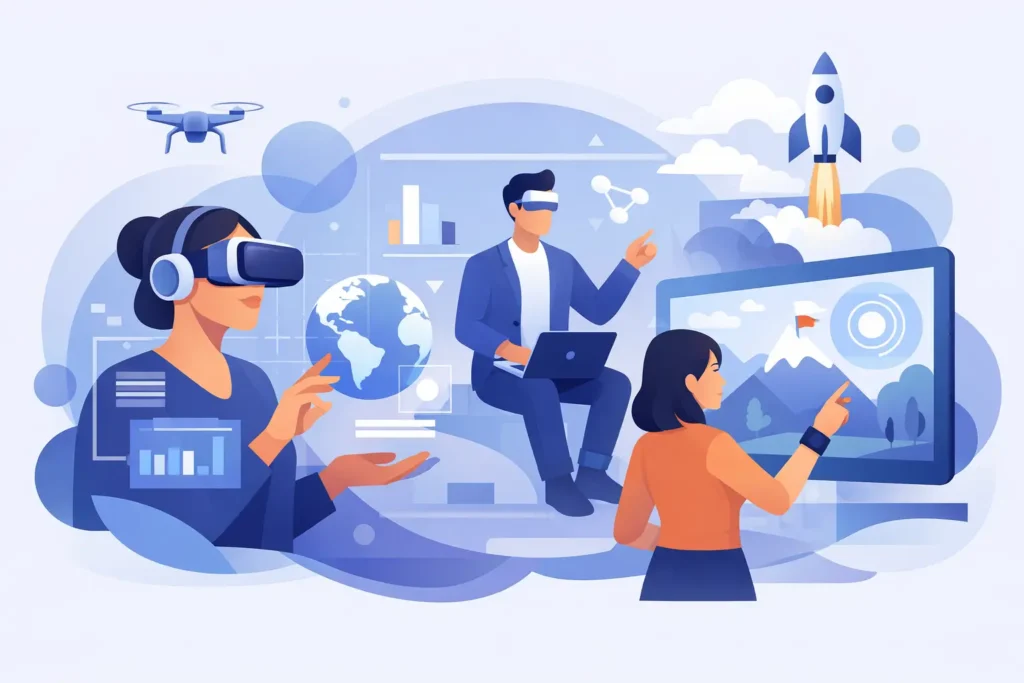
Immersion is often reduced to a headset, a 3D world, or expensive hardware. Those tools can be powerful, but they are not the whole story. A learning experience becomes immersive when the learner has agency, receives meaningful feedback, and sees knowledge change what they can do next.
That can happen in a mobile word game, a PC role-playing game, a simulation, or virtual reality. The common thread is not the screen. It is the design. The learner is not standing outside the subject, waiting to be tested on it later. They are making choices inside a system where knowledge has practical value.
The strongest trend is therefore not VR alone. It is the move from content delivery to knowledge-powered play. Players are increasingly looking for games that respect their time while giving them something lasting in return. Parents and educators are looking for the same thing, with higher expectations for instructional substance and measurable skill growth.
Learning Is Becoming a Core Game Mechanic
For years, many educational games followed a familiar formula: complete a quiz, collect a badge, then return to another quiz. That is gamification layered on top of study. It can motivate short bursts of participation, but it rarely creates the feeling of being absorbed in a game.
A more promising approach makes the skill part of the play loop. Language vocabulary might reveal clues, enable dialogue choices, or help a player navigate a challenge. Financial literacy might shape how a player manages resources and responds to risk. STEM concepts might help them diagnose a problem, build a tool, or understand why a strategy works.
This is harder to build than a point system. It demands real game design and real curriculum design working together. The game must remain fun if the player is already familiar with the subject. The lesson must remain useful if the player is motivated mainly by the game. When either side is treated as an afterthought, players notice.
That is why the next generation of learning games will be judged less by whether they contain educational content and more by whether the content has a job to do. If knowledge does not influence the player’s decisions, it is probably a worksheet wearing a costume.
The right friction creates memory
Not every learning moment should be effortless. Productive struggle matters. A player who has to infer meaning from context, test an idea, make a mistake, and try again is building stronger mental connections than someone who simply recognizes the correct answer.
The trade-off is pacing. Too much friction turns a game into homework. Too little produces shallow interaction that feels satisfying but does not stick. Great immersive learning designs place difficulty where it creates curiosity, then give players enough feedback to understand what changed and why.
VR Is Moving From Novelty to Perspective
Virtual reality remains one of the most visible immersive learning trends because it can make abstract systems feel immediate. Climate change, for example, is easy to discuss at a distance and much harder to ignore when a player can experience the human and environmental stakes through an interactive world.
VR is particularly effective when perspective is part of the lesson. It can place learners in situations they could not safely, affordably, or ethically experience in real life. A simulation can make a complex process visible. An interactive scenario can show how one decision affects another. A well-built virtual environment can turn passive awareness into a memorable emotional encounter.
Still, VR is not automatically better instruction. Headsets cost money, some users experience discomfort, and a visually impressive experience can become a guided tour with little agency. The best use cases give players a reason to observe closely, make decisions, and reflect on consequences. Presence is valuable, but participation is where learning becomes durable.
For broad access, VR should also be part of a larger ecosystem rather than the only doorway. Mobile and PC experiences can reach learners wherever they are, while VR can deliver high-impact moments where embodiment genuinely adds value.
Adaptive Systems Need Better Goals
Adaptive learning systems are becoming more sophisticated at adjusting difficulty, tracking performance, and identifying weak spots. Used well, this can prevent a common failure of one-size-fits-all instruction: bored learners disengage, while overwhelmed learners quit.
But adaptation should not mean reducing every player to a stream of correct and incorrect answers. A smart system can respond to more than accuracy. It can recognize hesitation, repeated choices, preferred play styles, and the kinds of challenges that sustain engagement. It can offer a different path through a quest, introduce practice at the moment it is useful, or revisit a concept after enough time has passed for recall to matter.
The caution is clear. Personalization can become manipulative if it is designed only to maximize screen time. Learning products should optimize for competence, confidence, and meaningful return, not compulsive loops. Players deserve to know what they are building and to feel that progress outside the app is real.
Credibility Is Becoming Part of the Experience
As the market fills with products that promise to make learning fun, audiences are getting better at asking a simple question: does it actually teach?
That question changes how educational games should be made and marketed. Strong claims need strong foundations, whether that means academically designed curriculum, subject-matter expertise, thoughtful assessment, or clear explanations of how mechanics support retention. Fun is not a substitute for rigor. Rigor is not an excuse for dull design.
This is where studios such as Riot Shield Games have an opportunity to set a higher standard. A game can be entertaining enough to compete for a player’s evening and intentional enough to leave them smarter than when they started. That combination is not a compromise. It is the point.
Assessment also needs to feel native to the experience. Instead of interrupting play with constant multiple-choice checks, games can observe whether players apply knowledge in new contexts. Can they use a word in an unfamiliar situation? Can they make a sound resource decision when the numbers change? Can they explain a system through the choices they make? Transfer is a better signal than a streak.
Social Learning Is Returning, With Better Tools
Learning has always been social, even when school software acted like it was not. Multiplayer games, community challenges, shared problem-solving, and creator communities are bringing collaboration back into digital learning.
The appeal is bigger than competition. Working with others gives learners a reason to articulate what they know, compare approaches, and see that skill is not fixed. A cooperative puzzle can reward communication. A shared language challenge can make practice feel less isolating. A community built around improvement can turn a private goal into a habit supported by other people.
There are trade-offs here too. Competitive leaderboards can motivate experienced players while discouraging beginners. Social features need moderation and clear norms, especially for younger audiences. The goal is not to make every lesson public. It is to offer connection where connection improves persistence and understanding.
What to Watch Next
The most exciting immersive learning experiences will not ask players to choose between having fun and making progress. They will treat those outcomes as connected. They will use narrative to create stakes, systems to create practice, and feedback to make improvement visible.
For learners, the practical question is not whether a product calls itself educational. Ask what you actually do inside it. Do you make decisions using the skill? Do mistakes teach you something useful? Does progress mean more than earning another cosmetic reward? If the answers are yes, the experience has a chance to outlast the initial novelty.
Choose learning experiences that make you want one more turn because you are curious what you can do next, not because you are trapped in a reward loop. That is where play becomes practice, and practice starts changing what you know.