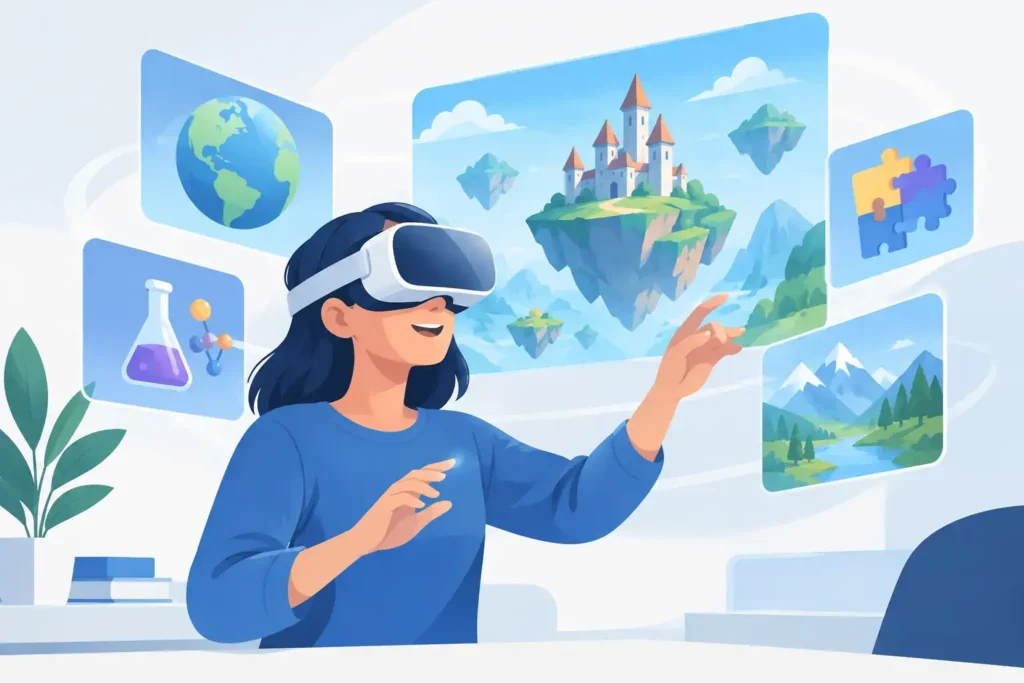
A learner is standing in a storm-battered virtual coastline, trying to keep a community powered as sea levels rise. Another is negotiating with a character in Japanese, where choosing the wrong phrase changes the mission. Neither experience feels like a worksheet. That is the point. The future of immersive learning is not more content poured into a headset or pasted onto a game. It is learning designed so well that progress in the game requires progress in the skill.
For decades, education software has often asked players to tolerate the game-like layer in order to reach the lesson. A quiz appears between rewards. Flashcards get points. A cartoon mascot congratulates you for doing the same rote work in a brighter color palette. That approach can help with repetition, but it rarely creates the feeling that makes great games powerful: purposeful action, meaningful feedback, and the urge to try one more time.
Immersive learning has a higher standard. Knowledge cannot be an interruption. It has to become part of the player’s strategy.
The Future of Immersive Learning Won’t Feel Like Homework
The strongest learning games will not win because they are educational. They will win because they are compelling games that happen to leave players more capable than when they started.
That changes the design question. Instead of asking, “How do we make this lesson fun?” creators should ask, “What can a player do only after they understand this idea?” In a language game, vocabulary becomes a tool for navigating a social encounter, uncovering a clue, or making a tactical choice. In a finance game, budgeting is not a detached calculation. It is how the player protects a team, funds an expedition, or recovers from a bad decision. In a climate experience, systems thinking is what reveals why a quick fix may create a harder problem later.
When the skill changes what the player can accomplish, learning gains stakes. The player is no longer studying for a test that exists outside the experience. They are learning because they want to succeed inside it.
This is where immersive formats have an advantage over passive video and conventional study tools. They can place learners inside a system and let consequences unfold. Reading about supply and demand is useful. Managing scarce resources while a virtual community reacts to shortages makes the same principle harder to ignore. Hearing a phrase in another language is a start. Using it at the right moment, under pressure, creates a memory with context.
Presence Is Powerful, but It Is Not Enough
Virtual reality, augmented reality, and interactive simulations can create an extraordinary sense of presence. A well-built environment can make distant places, historical events, microscopic systems, or future climate scenarios feel immediate. That emotional connection matters, especially when the subject is complex or easy to dismiss as abstract.
But presence alone does not guarantee learning. A spectacular VR experience can still be a field trip with no follow-through. A beautiful simulation can still overwhelm learners if it gives them too many controls before they understand the rules. The medium can amplify attention, but attention must be directed.
The best immersive learning systems pair sensory impact with clear instructional design. They introduce one meaningful decision at a time. They let players test a hypothesis, see the result, adjust, and try again. They revisit important concepts in new contexts so knowledge becomes flexible instead of fragile.
That is also why game design discipline matters. Good onboarding, readable feedback, balanced challenge, and smart pacing are not cosmetic details. They determine whether a player stays engaged long enough to practice. A lesson does not become effective because it is delivered in 3D. It becomes effective when the learner understands what they are trying to do, receives useful information about how they are doing, and feels capable of improving.
The real engine is agency
Agency is the difference between being shown an answer and discovering why an answer works. Players remember choices because choices belong to them. If they mismanage a resource, misread a conversation, or overlook a scientific variable, the system can respond in a way that teaches without scolding.
That response needs to be fair. Failure should reveal information, not simply shut the door. A player who gets an answer wrong should gain a clue about the underlying concept and a reason to attempt a better strategy. This is a familiar principle in great games: setbacks are part of the loop, not evidence that the player does not belong.
For learners who have been discouraged by traditional classrooms, that distinction is enormous. A game can turn “I’m bad at this” into “I need a different approach.”
AI Will Make Practice More Responsive
Artificial intelligence will shape the future of immersive learning, but the most valuable use will not be generating endless lectures or replacing human teachers. It will be making practice more responsive.
Imagine language-learning characters that recognize whether a player is relying on memorized phrases, then shift the conversation to test genuine comprehension. Imagine a science simulation that notices a learner repeatedly confusing correlation with causation and introduces a new scenario built around that exact misconception. Imagine a personal finance game that adapts its difficulty based on decisions, not just right-or-wrong answers.
Used well, AI can help immersive experiences feel less like a fixed maze and more like a coach that meets players where they are. It can personalize pacing, vary examples, and create more natural dialogue. For independent studios, it may also make ambitious simulation and narrative systems more feasible to build.
There are real limits. Adaptive systems can become opaque if players cannot understand why the experience changed. Poorly designed AI feedback can be confidently wrong, culturally shallow, or too eager to help. In education, a convenient answer is not always a useful one. Sometimes productive struggle is exactly what helps a concept stick.
The goal should be intelligent scaffolding, not an invisible autopilot. Players still need room to make choices, notice patterns, and earn mastery.
Measurement Has to Respect the Player
As immersive learning grows, the pressure to prove results will grow with it. That is healthy. Educational games should be held to a higher bar than engagement time, download counts, or completion badges.
Yet measurement can also ruin the experience if it becomes intrusive. Players do not want to feel like every move is being harvested for a dashboard. Developers and educators need to be deliberate about what they track, why they track it, and how they protect privacy, especially for younger audiences.
The most useful measures go beyond whether a learner completed a level. Can they use the concept in a new situation? Can they explain a decision? Do they return voluntarily and improve over time? For language learners, recognition matters, but so does confident use. For STEM learning, getting the right answer matters, but so does understanding the system that produced it.
This is where academically grounded curriculum and game development need each other. Curriculum without strong mechanics can feel dutiful. Mechanics without learning goals can be entertaining but shallow. The opportunity is to build experiences where the data reflects real growth because the gameplay demands real thinking.
Immersion Must Be Accessible, Not Exclusive
The future will not belong only to expensive headsets and high-end PCs. VR can create unmatched presence, but it is not always the right format. Some learners experience motion sickness. Some do not have the hardware, space, time, or physical comfort required for headset-based play. A mobile puzzle game may be more practical for a commuter learning vocabulary in five-minute sessions. A PC RPG may offer the depth needed for a long-form learning journey.
The right level of immersion depends on the skill and the audience. A useful rule is simple: use the technology that makes the learning action clearer, richer, or more memorable. If a 2D interface teaches the idea better, use 2D. If spatial presence helps learners understand scale, consequence, or physical process, VR may be worth the added complexity.
Accessibility also means designing for different learning needs from the start. Captions, adjustable text, remappable controls, flexible pacing, color-aware interfaces, and multiple ways to receive information should be part of the design process, not a late patch. More people can learn through play when the game respects the many ways people play.
What Learners Should Demand Next
The next generation of learning games should be more ambitious than digital flashcards and more accountable than empty gamification. Players should expect real gameplay, clear learning value, and enough depth to reward their time.
Look for experiences where the subject matter changes the decisions you make. Look for feedback that teaches rather than merely judges. Look for systems that respect your curiosity instead of treating your attention as something to trap. Riot Shield Games builds toward that standard: games where the challenge is not separate from learning, but the reason learning happens.
The most exciting possibility is not that every classroom becomes virtual or that every learner puts on a headset. It is that more people discover they can build knowledge the same way they build skill in a great game: through curiosity, experimentation, failure, persistence, and the satisfaction of finally seeing how the pieces fit.
Choose learning experiences that make you want to come back. When the next challenge asks more of your mind than your memory, you are not just passing time on a screen. You are leveling up.