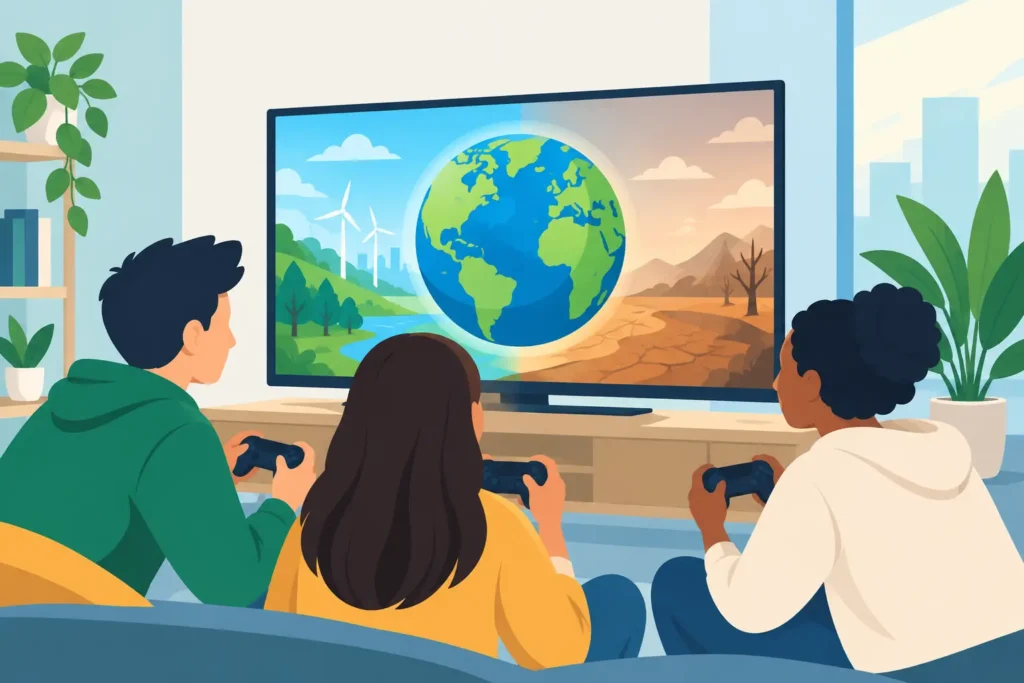
A player is standing on a virtual shoreline. A storm is coming. They have limited resources, competing priorities, and one uncomfortable question: protect homes now, restore wetlands, or invest in a system that may not pay off until years later? That moment is climate education at its best. Not a slide deck. Not a guilt trip. A meaningful decision with consequences the learner can see, test, and remember.
Climate change is often taught as a pile of facts that are individually alarming and collectively paralyzing. Carbon dioxide levels. Rising temperatures. Extreme weather. Sea-level projections. The information matters, but information alone does not automatically create understanding. People need a mental model of how systems connect, where trade-offs appear, and what action can actually accomplish.
Games are unusually good at building that model because they make systems playable. They turn abstract forces into choices, feedback, constraints, and outcomes. Done well, they do not make climate change feel smaller than it is. They make it feel legible.
Why Climate Education Needs Better Experiences
Most people already know climate change is real. The harder challenge is climate literacy: understanding why it happens, who is affected, how responses differ, and where individual, community, business, and government choices fit together.
That is a difficult subject because it is not one subject. Climate learning pulls from earth science, biology, economics, engineering, public policy, ethics, and history. It also asks learners to think across time. A choice made now can shape conditions decades from now, while the people bearing the heaviest costs may not be the people making the decision.
Conventional instruction can explain these relationships, but it often struggles to make them felt. A chart can show that a hotter atmosphere holds more moisture. A game can let players experience what that means when flooding disrupts food supplies, damages infrastructure, and forces a city to make hard budget choices. Neither format replaces the other. Strong climate education needs clear teaching, credible data, discussion, and practice. But interactive play adds something lectures cannot: agency inside a system.
That agency matters. When learners only receive bad news, they may leave with fear but no framework for response. When they are asked to make decisions, revise their strategy, and observe results, they begin to see climate action as a set of real, contested, solvable problems.
What Games Can Teach That Facts Alone Cannot
Games excel when the lesson depends on relationships rather than recall. Climate systems are full of relationships: emissions affect warming; warming affects weather patterns; weather affects health, agriculture, migration, and infrastructure; policy choices can protect one group while leaving another exposed.
A well-designed simulation can teach cause and effect without pretending that every outcome is predictable. Players might choose between clean energy investments, public transit, building efficiency, ecosystem restoration, and emergency preparation. Each option has costs. Each may produce benefits on a different timeline. Some reduce future risk. Some help communities survive the damage already underway. The point is not to identify one magic button. The point is to understand why effective responses require portfolios of action.
Games can also make trade-offs visible. A player who allocates all available funds to immediate disaster relief may save lives in the short term but have less capacity to reduce future emissions. A player who focuses only on long-range mitigation may leave vulnerable communities without needed protection today. These are not arguments against action. They are the real tensions leaders, families, and communities confront.
This is where good game design and good instruction meet. The player needs enough freedom to experiment, but enough structure to learn from the experiment. Feedback must be clear. If a decision fails, the game should help the player understand why instead of treating failure as random punishment. If a decision works, the game should reveal the conditions that made it work.
Climate Education Should Build Agency, Not Anxiety
Climate communication can fail in two opposite ways. It can soften the crisis until it feels distant and optional, or it can present catastrophe so relentlessly that learners shut down. Neither approach prepares people to participate in the world they inherit.
The goal is honest agency. That means acknowledging uncertainty without using uncertainty as an excuse for inaction. It means showing that no single person can solve a global problem alone, while also showing that individual choices can connect to larger efforts through voting, careers, community organizing, consumption, design, research, and local resilience.
For teens and young adults especially, this distinction is crucial. They are often told they are the future while being handed systems they did not create. Climate education should not place the entire burden on them. It should give them language for the problem, evidence for evaluating claims, and confidence to identify where their effort can matter.
A game can support that process by making collective action part of the mechanics. Instead of rewarding a player only for personal survival or profit, it can reward collaboration, long-term thinking, equitable outcomes, and informed compromise. Players learn that success is not simply maximizing one number. It is protecting people, maintaining ecosystems, and building capacity for a changing future.
The Design Rules That Make Learning Stick
Not every game with a green color palette is climate education. A meaningful learning experience needs more than a climate-themed story or a few facts in dialogue. It needs instructional intent built into the core loop.
First, the player’s actions should map to real concepts. If a game teaches energy systems, players should encounter ideas such as generation, storage, demand, reliability, land use, and emissions. If it teaches coastal resilience, choices should reflect the difference between adaptation, mitigation, restoration, and emergency response.
Second, feedback should be immediate enough to understand and realistic enough to respect complexity. Real climate outcomes often unfold over years, so games may compress time. That is fine if they make the compression clear and avoid suggesting that policy produces instant, guaranteed results.
Third, the game should reward curiosity rather than rote guessing. A player should be able to test a strategy, inspect what happened, and try again with better reasoning. Failure becomes productive when it reveals a relationship the player had not seen before.
Finally, accuracy must be nonnegotiable. Climate games can simplify, but they cannot casually distort the science to create drama. The best projects work with educators, researchers, and subject-matter experts, then translate that knowledge into mechanics people actually want to play.
From Passive Concern to Playable Understanding
The strongest climate learning experiences do not ask players to memorize a slogan and move on. They ask better questions. What happens when a city grows faster than its infrastructure? Why might a solution that works in one region fail in another? Who benefits, who pays, and who gets a seat at the table?
Those questions can make climate education more demanding, but also more compelling. Players are not empty containers waiting for facts. They are problem-solvers. Give them a system worth understanding, meaningful constraints, and room to think, and they will engage far more deeply than they would with another passive lesson.
This is the opportunity for educational games. Riot Shield Games believes play can carry serious ideas without draining them of energy, challenge, or imagination. An immersive climate experience can turn a subject that feels impossibly large into a place where learners practice attention, judgment, and informed action.
The standard should be higher than awareness. Learners deserve experiences that help them recognize misinformation, understand competing priorities, and see themselves as capable participants in collective solutions. Climate education becomes powerful when it leaves people not merely worried about the future, but better prepared to help shape it.
The next time a learner asks, “What can I do?” the best answer may not be a lecture. It may be a world they can enter, test, question, and leave smarter than when they started.