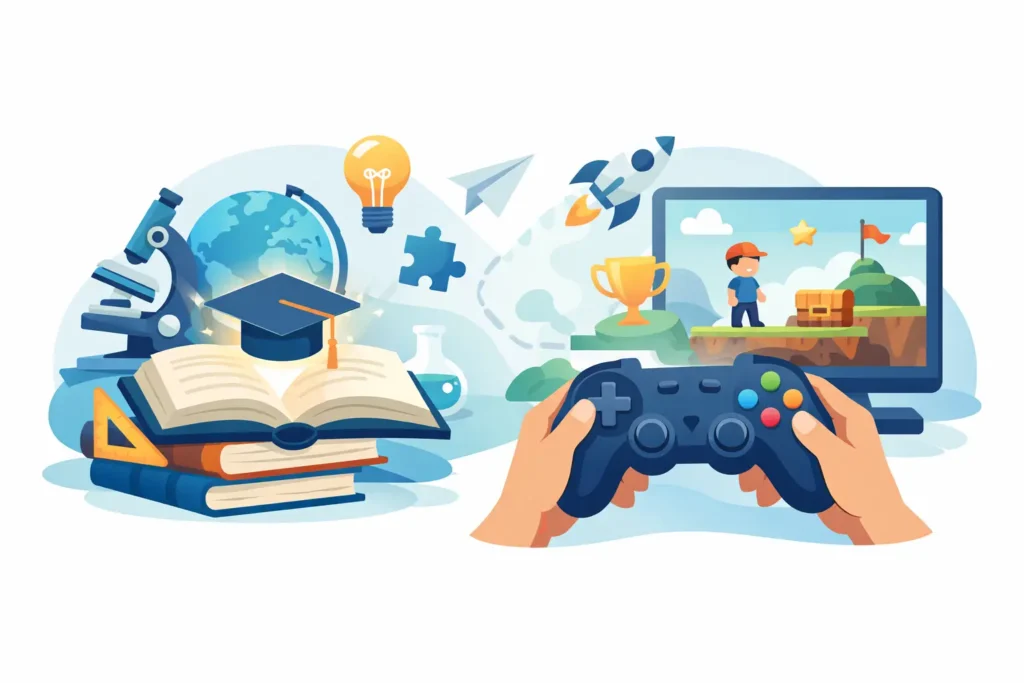
A vocabulary drill with a cartoon badge system is not the same thing as a game that actually teaches through play. That distinction matters. If you are asking what is educational gaming, the real answer is not “any game with facts in it.” Educational gaming is the design of interactive play experiences where the mechanics themselves help players build knowledge, practice skills, and retain what they learn.
That sounds simple, but the gap between educational gaming and old-school edutainment is huge. One feels like homework wearing a fake mustache. The other makes learning feel earned, satisfying, and worth coming back to.
What is educational gaming?
Educational gaming is gameplay built with a learning outcome in mind, where progress in the game is tied to understanding something real. That might mean language acquisition, math fluency, financial literacy, scientific reasoning, or climate awareness. The key is that the player is not just consuming information between levels. They are learning by acting, deciding, experimenting, and adapting.
At its best, educational gaming treats the brain like part of the controller. You are not memorizing in a vacuum. You are solving problems under pressure, recognizing patterns, managing resources, recalling concepts at the right moment, and seeing immediate feedback on your choices.
That is why strong educational games tend to feel fundamentally different from quizzes wrapped in bright colors. A true learning game does not pause the fun so the lesson can begin. The lesson is embedded in the fun.
Why educational gaming works when it works
Games are powerful learning environments because they are built around feedback loops. You try something, see the result, adjust, and try again. That cycle is exactly how many real skills are developed.
In a well-designed educational game, repetition stops feeling repetitive because it has context. Practicing Japanese vocabulary inside a puzzle system or using math to manage resources in a strategy loop feels different from staring at a worksheet. The player has a reason to care. There is momentum, tension, reward, and often a sense of mastery that traditional study tools struggle to create.
Motivation is the big differentiator. Most people do not quit learning because they are incapable. They quit because the process is dull, disconnected, or mentally draining in the wrong way. Educational gaming can reduce that friction by making practice intrinsically rewarding.
That does not mean games are magic. It means they can align effort with enjoyment better than many traditional tools.
The difference between educational gaming and edutainment
This is where the conversation gets more honest. A lot of products call themselves educational games when they are really content delivery systems with light interactivity.
Edutainment often puts learning content next to gameplay. Answer a question, get a coin. Watch a lesson, unlock a mini-game. That model can work for certain audiences, especially younger kids, but it often breaks immersion. Players can feel the split instantly. One part is the medicine. The other part is the sugar.
Educational gaming, in the stronger sense, merges the two. If you are learning a language, the game world may require comprehension, recall, and use of that language to progress. If you are learning finance, your strategic choices may depend on budgeting, risk management, or long-term planning. If you are learning science, experimentation and systems thinking may be the core challenge.
That integration is harder to design. It demands both serious game design and serious instructional thinking. But it is also what makes the experience stick.
What educational gaming can actually teach
The short answer is more than people think, but not everything equally well.
Educational gaming is especially strong for skills that benefit from repetition, decision-making, pattern recognition, and applied practice. Languages are a natural fit because games can reinforce vocabulary, reading, listening, and contextual recall over time. STEM topics can work well when players interact with systems, test ideas, and see cause and effect. Personal finance also fits because games naturally deal with trade-offs, planning, scarcity, and consequences.
Games can also support softer skills like persistence, problem-solving, and strategic thinking. That said, some subjects are easier to gameify than others. Nuanced writing instruction, for example, can be harder to translate into compelling mechanics than spatial reasoning or memorization-based tasks. Complex learning goals often need a mix of approaches.
So the honest answer is that educational gaming is powerful, but it depends on the subject, the design, and the learner.
What separates a good educational game from a bad one
A good educational game respects both halves of the equation. It respects the player enough to be genuinely fun, and it respects the subject enough to teach it accurately.
Bad educational games usually fail on one side or both. Some are technically educational but so boring that players bounce off before learning much. Others are entertaining but educational in name only, offering trivia-level exposure without meaningful skill development.
The strongest games share a few traits. They have clear feedback, so players know why they succeeded or failed. They create a real gameplay reason to use the target skill. They scale difficulty in a way that keeps players challenged without overwhelming them. And they avoid treating learning as a pop-up interruption.
Academic grounding matters too. If a game claims to teach language, science, or finance, the instructional design should hold up. Otherwise, players may build shaky understanding or false confidence, which is worse than no learning at all.
What is educational gaming for different audiences?
For students, it can be a way to get more reps without burnout. Instead of forcing another round of passive review, games can turn practice into something active and self-directed.
For lifelong learners and young professionals, educational gaming offers a smarter use of screen time. Plenty of people want to learn Japanese, sharpen mental math, or understand money better, but they do not want another sterile app nagging them with streaks. A well-made game can meet the same goal with more energy and better retention.
For parents and educators, the appeal is different. The question is not just whether a game contains educational content. It is whether the game produces meaningful engagement and measurable progress. Flashy interfaces are easy. Sustained learning is harder.
That is why quality matters so much in this category. If the design is shallow, players notice. If the pedagogy is weak, the learning outcome suffers.
The trade-offs people should be honest about
Educational gaming is not automatically better than traditional learning. Sometimes a textbook explanation is faster. Sometimes flashcards are the most efficient way to brute-force memorization. Sometimes a game adds friction where none is needed.
There is also the risk of over-gamifying learning. If every educational experience relies on rewards, streaks, and constant stimulation, some learners may struggle with slower forms of study that still matter. Good educational gaming should build competence, not just dependence on external reward loops.
Development is another trade-off. Great educational games are hard to make because they sit at the intersection of curriculum design, psychology, and game systems. You cannot fake either side. The result is that many products in the space are either educational software pretending to be games or games making educational claims they have not earned.
That is exactly why this category needs higher standards, not lower expectations.
Why educational gaming matters now
People are exhausted by shallow screen time. They want entertainment, but they also want progress. They want to feel sharper after they play, not just distracted. That shift creates a real opportunity for educational gaming to grow beyond the old stereotypes.
The best version of this space is not about replacing teachers, books, or serious study. It is about expanding how learning can happen. A game can create emotional investment, repeated exposure, and active problem-solving in ways many traditional formats cannot.
That is the real promise. Not making education cute. Making it compelling.
Studios like Riot Shield Games are pushing in that direction by treating learning content with real seriousness and game design with equal respect. That balance is what the category needs if it wants to earn trust from players, parents, and educators alike.
So what is educational gaming? It is not a gimmick, and it is not just screen time with a moral excuse. At its best, it is a smarter form of play – one that leaves you with stronger skills, deeper knowledge, and a reason to keep going. Play should not have to compete with learning. Done right, it becomes one of the best ways to learn.