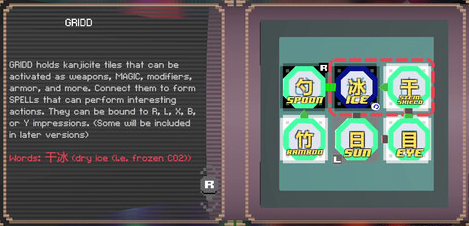
The heart of The Adventure of Spyke isn’t the combat. It’s the kanjicite crystal crafting system. Every weapon you forge begins with an octagonal crystal, and every crystal is a real Chinese or Japanese character.
Here’s the idea: to build a weapon, you place, rotate, and connect crystals in a logical chain – element to modifier to implement. A fire crystal (火) chained to a projectile shapes a fireball; swap in water (水) and now it’s an enchanted ball of liquid. You’re not memorizing flashcards. You’re making decisions under pressure, and the characters stick because they mean something in the moment you use them.
Why crafting, and not quizzing?
Traditional language games quiz you. Spyke makes the language load-bearing. If you don’t understand what 雷 (thunder) does, your build is weaker; so you learn it because you want the better weapon, not because a timer is counting down.
Each crystal carries its reading, meaning, and a short example of use, surfaced the instant you handle it. Over a play session you’ll touch dozens of characters, and the ones you rely on become second nature.
Designed by a PhD, balanced like a game
The system was designed by an MIT-educated electrophysics PhD, and it shows in the internal logic: mana isn’t a single bar but a budget you balance across your whole arsenal. The “physics of magic” is consistent, which means the language and the strategy reinforce each other instead of competing.
More blogs on the crafting UI, the scan system, and controller-first design are on the way. Thanks for following along.