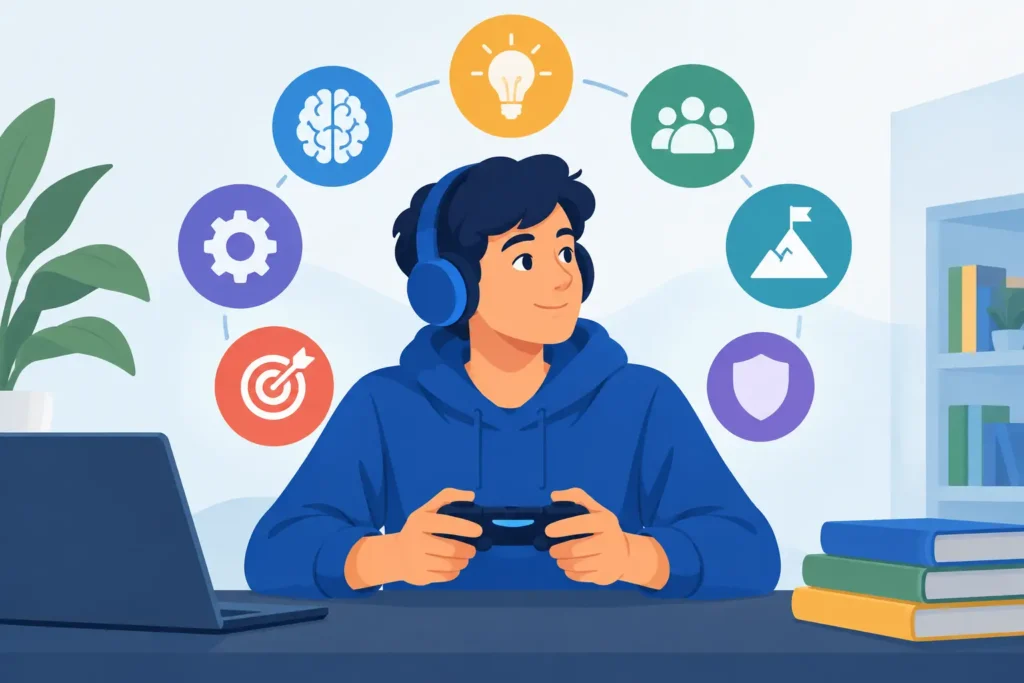
A player who spends an hour making fast decisions in a strategy game, decoding a Japanese clue, or balancing an in-game budget is not automatically learning. But they might be doing something far more powerful than passively watching an educational video: practicing a skill because they want to win.
That distinction is the answer to the question, do games educate? Yes, they can – but only when learning is built into what the player actually does, not pasted onto the reward screen after the fun is over.
Do Games Educate, or Just Keep Us Busy?
Games have always taught players something. A competitive fighting game teaches timing, prediction, and emotional control under pressure. A city builder teaches systems thinking. A cooperative raid teaches communication and role awareness. Even games with no academic curriculum can sharpen pattern recognition, spatial reasoning, persistence, or strategic planning.
But educational value is not the same as educational intent. A game can demand attention without building knowledge that transfers beyond the game. Memorizing the most efficient weapon stats may improve performance in that title, but it does not necessarily teach physics, mathematics, or financial literacy.
The stronger question is not whether games can teach. It is: what is the player repeatedly practicing, why does it matter, and can they use it somewhere else?
A well-designed educational game answers all three. It gives players meaningful actions, immediate consequences, and reasons to return. The curriculum is not a lecture interrupting gameplay. It is part of the challenge itself.
Learning Sticks When It Has a Job to Do
Traditional study often asks learners to memorize first and trust that the material will become useful later. Games can reverse that order. They create a problem, make the problem matter, and give knowledge a clear job to do.
Consider language learning. A vocabulary list can tell a learner that a Japanese word means “door.” A game can make that word necessary for opening a route, helping a character, solving a puzzle, or avoiding danger. The player is not recalling it to satisfy a worksheet. They are recalling it because they have a goal.
That changes the emotional texture of practice. Repetition feels less like rote memorization when each attempt produces feedback. Get the answer right, and progress opens up. Miss it, and the player gets another chance to notice the pattern, adjust, and try again. This loop supports several learning principles at once: retrieval practice, repetition over time, contextual understanding, and feedback close to the moment of error.
The same logic works for STEM and personal finance. A player who must estimate resources, compare trade-offs, test a hypothesis, or plan for an uncertain outcome is using concepts in context. If the game makes those decisions legible, then the player can begin to understand not just what an answer is, but why it works.
The Difference Between a Game With Facts and a Learning Game
Not every game that contains educational facts is educational. A trivia question between levels may add information, but it rarely changes how the game is played. The knowledge is detachable. Remove it, and the core experience remains the same.
A learning game is stronger when the knowledge and the mechanic are inseparable. In a language puzzle, comprehension should help players solve the puzzle. In a finance game, budgeting should shape the player’s options. In a climate experience, systems such as emissions, infrastructure, and human choices should influence what the player sees and can change.
This is the design standard that matters: if a player ignores the learning content, can they still play effectively? If the answer is yes, education is probably decoration. If the answer is no, the game has a chance to make learning feel native to play.
That does not mean every moment needs to resemble a test. Great games use story, surprise, exploration, mastery, and humor to create motivation. The goal is not to disguise a textbook so completely that players never realize they are learning. The goal is to make learning worth doing because it produces competence, agency, and progress.
Why Motivation Is More Than a Nice Bonus
Motivation is often treated as the soft side of education, separate from serious learning. It is not. Motivation determines whether someone starts, persists through mistakes, and comes back often enough to build skill.
Games are unusually good at making effort visible. Experience points, new abilities, maps, collections, quests, and escalating challenges show players that they are moving forward. More importantly, strong games create a sense of earned mastery. Players can feel themselves becoming better at something.
That feeling matters for learners who have been told they are “bad at languages,” “not a math person,” or incapable of understanding money. A game can give them a lower-stakes place to fail, experiment, and improve. Instead of treating an incorrect answer as a verdict, it becomes information. The next attempt is part of the game.
For teens, college students, and busy adults, this can turn scattered minutes into real practice. A five-minute session will not replace a full course on its own. But it can build consistency, and consistency is where meaningful gains begin.
Where Educational Games Can Fall Short
The case for game-based learning should not become a sales pitch for every app with badges and a leaderboard. Games have limits, and good learning design respects them.
First, fun does not guarantee transfer. A player may become excellent at a game’s internal rules without being able to apply the underlying concept in a new setting. This is why explanation, varied scenarios, and opportunities to use knowledge outside a single mechanic matter.
Second, rewards can become a distraction. If players chase coins, streaks, or cosmetic items while skipping the thinking that the activity is supposed to encourage, the reward system is doing too much work. The best incentives point attention back to skill, not away from it.
Third, accuracy matters. A game about climate change, finance, or science carries real responsibility. Simplification is necessary for play, but misleading simplification can teach the wrong mental model. Educational content should be grounded in credible curriculum and shaped carefully around what the game can honestly represent.
Finally, different subjects need different kinds of play. Fast action can reinforce recognition and decision-making. Slow simulation may be better for complex systems. Narrative can build empathy and context. There is no single magic genre for learning.
What Great Educational Game Design Looks Like
The best educational games respect players enough to be both challenging and clear. They do not assume that a colorful interface or a clever premise is enough. They ask what a learner must understand, then build a compelling reason to use that understanding again and again.
That can mean a language-learning puzzle where word recognition creates real advantages. It can mean an action RPG where Japanese, Mandarin, STEM concepts, and financial decisions affect exploration and progression. It can mean virtual reality that makes climate systems feel immediate without reducing a complex global issue to a slogan.
At Riot Shield Games, that is the mission: build games that leave players smarter than when they started. The point is not to make school look like a game. It is to use the strengths of games – choice, feedback, challenge, and discovery – to make serious learning feel alive.
Play Is Practice With a Pulse
The most promising educational games do not ask players to choose between entertainment and self-improvement. They reject the false choice. A game can respect a player’s time, deliver genuine excitement, and create measurable opportunities to learn.
So, do games educate? They do when learning is part of the player’s path to mastery. When knowledge helps you solve, build, communicate, survive, or create, every session becomes more than screen time. It becomes practice with a pulse.
The next time you choose a game, look past the label. Ask what it asks you to notice, remember, decide, and understand. The answer may change what play is capable of becoming.