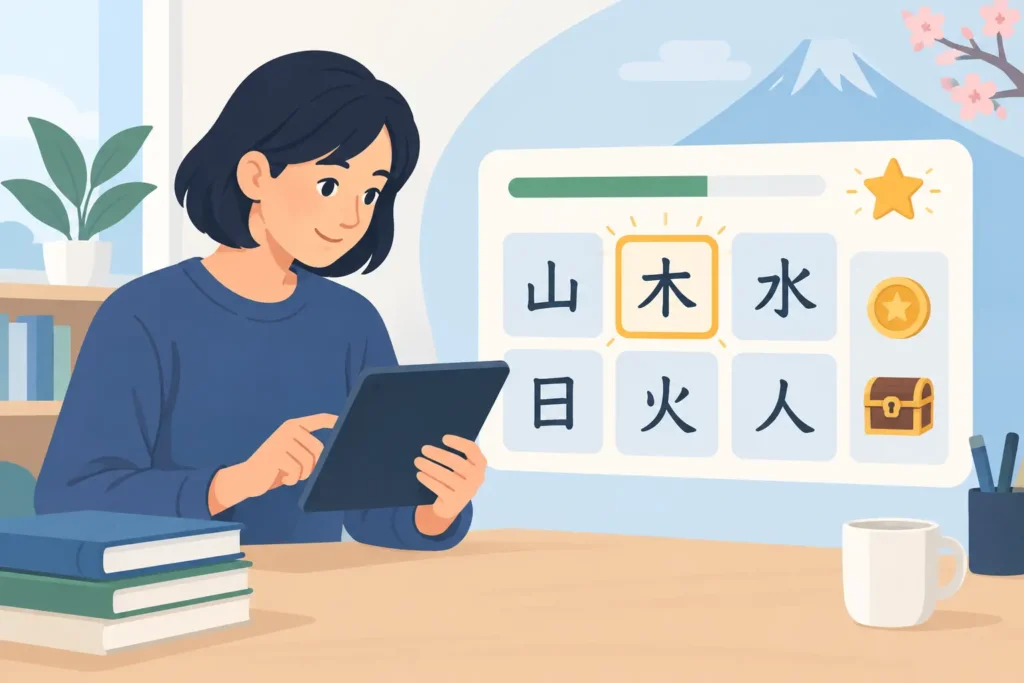
Kanji becomes frustrating when every character feels like a tiny test you are destined to fail. You recognize 木 in a menu, then blank on it five minutes later. You can copy 勉強 neatly, but cannot retrieve it when you need it. To memorize kanji with game mechanics, the goal is not to make study look playful. The goal is to turn every correct recall, useful mistake, and repeat encounter into part of a system worth returning to.
That distinction matters. A points counter pasted onto a flashcard app may make a session feel busier, but it does not necessarily make memory stronger. Real game design gives players clear goals, meaningful feedback, rising challenge, and a reason to make one more attempt. Those are exactly the conditions that can make kanji practice more durable.
Why Kanji Needs More Than Repetition
Kanji asks your memory to handle several jobs at once. You may need to recognize a character, connect it to one or more readings, understand its meaning, distinguish it from visually similar characters, and use it inside a word. Repetition helps, but undirected repetition often creates a false sense of progress.
Seeing a card that says 山 and thinking, “That is mountain,” is recognition. Producing 山 after hearing “mountain,” selecting the right reading in a word, or writing it from memory is recall. Recall is harder, which is precisely why it builds stronger access to the character later.
Games are good at making hard actions repeatable. A well-designed game does not ask you to stare at a sword icon for ten minutes and declare that you understand combat. It puts that tool into a sequence of decisions. You use it, get feedback, fail safely, adapt, and improve. Kanji learning benefits from the same structure.
Progress Must Represent Skill, Not Mere Attendance
A daily streak can get you through the door. It cannot prove you remember anything. If the only reward comes from opening an app, learners quickly discover the loophole: complete the smallest possible action, preserve the streak, and move on.
Better progression is earned through demonstrated memory. A character should advance when you retrieve it correctly after time has passed, identify it inside unfamiliar vocabulary, or distinguish it from a confusing neighbor. That makes the reward honest. Your visible progress reflects a growing ability to read Japanese, not just a growing number of sessions.
The Learning Loop That Makes Kanji Stick
The most useful game loop for kanji is compact: encounter a character in context, make a decision, receive immediate feedback, then meet it again after enough time has passed for forgetting to begin. That last part is where many systems weaken. Constantly repeating a kanji in the same minute can feel productive, yet it mostly trains short-term familiarity.
Spacing creates a more valuable challenge. If 水 appears after a delay, in a new word, or during a different task, your brain has to retrieve rather than echo. A game can frame that retrieval as a timed rescue, a puzzle solution, or a resource decision. The theme is flexible. The memory action is not.
Give Every Character a Job
Kanji is easier to retain when it does something. Rather than introducing 火 as a disconnected symbol, make it useful in a short decision: choose the correct sign, repair a word, identify an item, or complete a sentence where fire changes the outcome.
Context does not eliminate the need for direct study. You still need focused encounters with form, meaning, readings, and vocabulary. But context answers the question flashcards often leave hanging: why should this character matter to me right now? In a game, the answer can be immediate. This character opens the route, clarifies the clue, or gives you the information needed for the next move.
Make Mistakes Informative
Failure should cost attention, not dignity. If a learner confuses 休 with 体, the system should reveal the difference in a way that supports the next attempt: one contains person plus tree, the other person plus root. Then it should bring the pair back at a useful interval.
This is where games can outperform passive review. Good feedback is specific and actionable. “Wrong” is a dead end. “You chose the character with the body radical, but this word means to rest” teaches the learner what feature to inspect next time.
Use Difficulty Like a Level Designer
Early wins create momentum. Later tasks should demand more than matching English meanings to a single character. Once learners know a small set, challenge them with mixed vocabulary, similar-looking options, alternate readings, and sentence-level clues.
The trade-off is important. Push difficulty too fast and players begin guessing. Keep it too easy and they stop retrieving. A strong system adapts to performance, giving extra practice to fragile characters while letting reliable ones appear less often. The experience should feel like a fair challenge, not a punishment disguised as learning.
Game Mechanics That Actually Help Memory
Not every popular mechanic belongs in a learning game. Leaderboards can motivate competitive players, but they can also reward speed over accuracy and make beginners feel behind before they have started. Random loot can add surprise, but it should never replace a clear learning goal.
The mechanics with the strongest fit are the ones that reinforce deliberate recall. Quests work when they create a meaningful short-term objective, such as learning the kanji needed to understand a location or solve a dialogue puzzle. Collection systems work when completing a set requires accurate retrieval across several sessions. Combos work when they reward consecutive correct answers without turning one slip into a reason to quit.
Narrative can help, too, but only when it gives language a role. A story where Japanese text is decorative will not teach much. A story where reading a label, choosing the right phrase, or understanding a character name changes what happens creates a reason to pay attention.
At Riot Shield Games, that principle is central: play should not sit beside learning as an optional extra. The learning action belongs inside the game action. When the two are connected, players are not pausing the fun to study. They are studying because the fun asks them to think.
How to Memorize Kanji With Game Mechanics in 20 Minutes
You do not need hours of grinding to build a strong routine. Start with a small mission: five to eight new kanji, preferably connected by a theme or vocabulary set. Meet each one briefly, paying attention to its components and one useful word rather than trying to memorize every possible reading at once.
Next, spend a few minutes on active challenges. See the meaning and produce the kanji. See the kanji in a word and choose its reading. Compare look-alikes. If you miss one, do not immediately repeat it five times. Mark it as a rival, then bring it back after several other questions.
Finish with a context round. Read a few short words or sentences containing both new and older characters. The session should end with evidence that your knowledge works outside the original prompt. Tomorrow, revisit the characters you nearly forgot, not only the ones you enjoyed getting right.
A simple score can help, provided it measures the right thing. Award more progress for delayed recall, correct answers in context, and recovery after a mistake. Award less for instant repeats. The system teaches you what it values, so make sure it values memory that survives beyond the current screen.
Avoid Turning Study Into a Skinner Box
There is a line between motivating feedback and compulsive distraction. Excessive timers, constant rewards, and artificial scarcity can make learners chase the app instead of the knowledge. A session that feels exciting but leaves no trace in long-term memory is still wasted effort.
The best educational game mechanics respect the player. They create agency, offer clear evidence of improvement, and make difficult practice feel worthwhile. They also leave room for slower learners, busy adults, and anyone who needs repetition without being treated as if repetition is failure.
Kanji will always require attention. There is no honest mechanic that removes that cost. But a great learning game can make the effort feel like forward motion: one character recognized in a crowded sentence, one reading recalled under pressure, one small victory that carries into the real world. Play, learn, level up – then notice how much Japanese you can actually read.