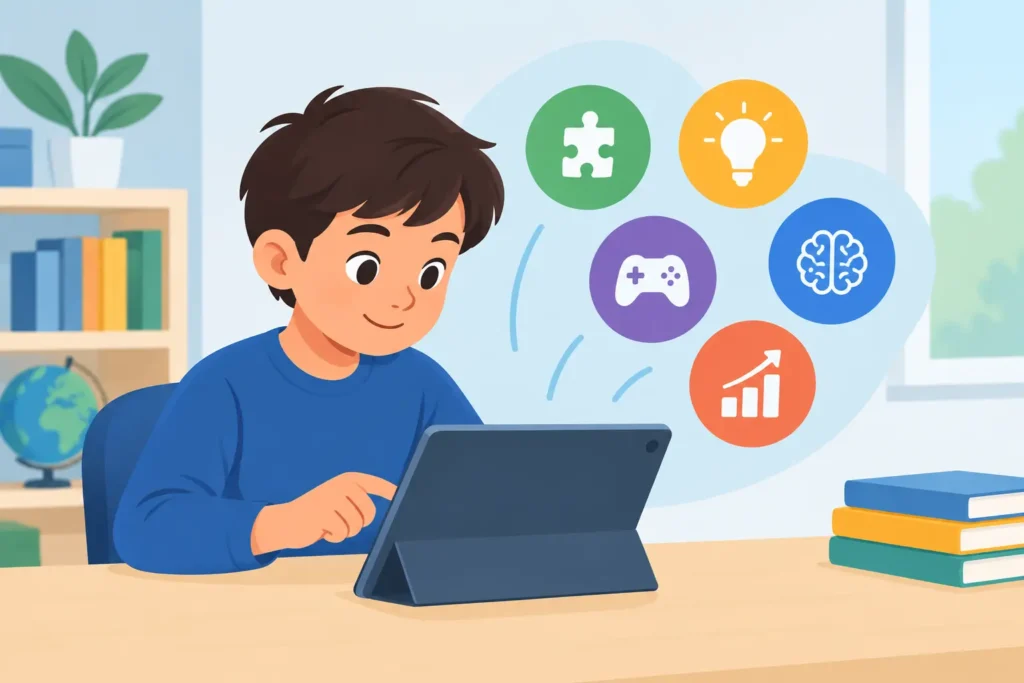
A game can call itself educational and still teach very little. Add a trivia question between levels, attach a vocabulary list to a matching game, and suddenly the label appears. But if the learning disappears the moment the player stops reading prompts, the game is not doing the real work.
Knowing how to choose learning games means looking beyond the subject on the box or app store page. The best ones make knowledge useful inside the game itself. You are not pausing the fun to study. You are studying because that is how you solve the puzzle, build the strategy, survive the encounter, or advance the story.
For gamers, learners, parents, and educators, that distinction changes what screen time can become. A well-designed learning game does not ask players to choose between entertainment and improvement. It gives them a reason to come back, then rewards that return with measurable growth.
Start with the skill, not the game genre
Before comparing screenshots, decide what success looks like. “Learn Japanese” is too broad. “Recognize 150 high-frequency Japanese words in context” is clearer. “Get better at math” becomes more useful when it means “understand proportional reasoning” or “practice mental arithmetic under light time pressure.”
A specific goal helps you avoid games that feel productive without building a durable skill. It also helps match the game to the player. A college student preparing for travel may need listening comprehension and everyday phrases. A middle schooler may need confidence with fractions. A curious adult may want to understand how carbon systems affect real climate decisions.
The goal should match the time you can realistically give it. A five-minute mobile puzzle can be excellent for vocabulary recall or quick financial concepts. It is less likely to deliver deep conversational fluency on its own. A longer PC role-playing game can make room for systems thinking, narrative context, and repeated practice, but it asks for more sustained attention. Neither format is automatically better. The right one fits the learning job.
How to choose learning games with real teaching design
The strongest learning games connect the core mechanic to the core lesson. That is the first test. Ask: if the educational material were removed, would the game loop still be basically the same?
If the answer is yes, the learning may be decorative. A platformer with occasional math pop-ups can still be enjoyable, but jumping is not practicing algebra. By contrast, a language puzzle where word recognition determines every move makes the target skill part of play. The player improves because progress demands improvement.
Look for a cycle of action, feedback, and adjustment. The game should let players try something, see the consequence, understand what happened, and use that information on the next attempt. That loop is where learning becomes active rather than passive.
Good instructional design also respects memory. A game should bring key ideas back after time has passed, vary the context, and make players retrieve knowledge instead of merely recognizing it from a list. In a language game, that might mean encountering a word in a puzzle, then later using it to interpret a clue. In a finance game, it could mean making a budget choice, seeing the trade-off, and revisiting the same principle in a tougher situation.
The best systems make mistakes useful. Failure should not be a dead end or a vague red X. It should reveal a gap, offer enough feedback to correct it, and create another chance to apply the lesson. That is game design with academic purpose.
Make sure challenge rises at the right pace
A learning game needs friction. If players can tap through every answer without thinking, they may collect rewards while retaining very little. But difficulty that spikes too early creates the opposite problem: players quit before the system has a chance to work.
Look for adaptive difficulty, smart level progression, or multiple modes that let players find an appropriate entry point. Beginners need early wins and clear explanations. More experienced players need complexity, not busywork. A game that treats every player identically can be fine for a narrow skill drill, but it often struggles with mixed-age classrooms and lifelong learners with uneven knowledge.
Pay attention to what makes the game harder. The ideal increase is not simply faster timers or more distractions. Those tools have a place, especially when speed matters, but they should not be the only source of challenge. Better progression asks for deeper understanding: longer sentences, more connected concepts, tougher strategic trade-offs, or less obvious clues.
For parents and educators, this is also where age ratings and reading level matter. A sophisticated subject can be appropriate for younger players when the language, visual design, and feedback are built for them. Conversely, a colorful interface does not make an advanced concept accessible by itself.
Judge the game loop, not just the lesson plan
Educational value cannot rescue a game that nobody wants to play twice. Motivation is not a bonus feature. It is the engine that creates enough practice for learning to stick.
Look for a clear reason to continue. That might be a compelling mystery, satisfying puzzle logic, character progression, creative building, competition, or a world that reacts to player choices. Rewards work best when they reinforce meaningful progress. Earning a new ability because you mastered a system feels different from receiving endless coins for tapping a button.
Be cautious with designs that rely heavily on streak anxiety, constant ads, or randomized rewards. These can drive short-term engagement, but they do not necessarily support focused learning. The goal is not maximum time spent. It is high-quality time spent thinking, experimenting, and improving.
A useful question is whether the game respects the player’s intelligence. Does it explain why an answer works? Does it trust players to notice patterns? Does it offer decisions with consequences? Great learning games make players feel capable, not managed.
Check whether the claims have substance
“Educational” is a marketing word until a developer shows its work. You do not need a research degree to evaluate credibility, but you should look for specifics. Strong developers identify the skills their game targets, explain how mechanics support those skills, and name the expertise behind the content.
That might include educator input, academically grounded subject matter, tested curriculum frameworks, or transparent learning objectives. For more ambitious topics such as language acquisition, personal finance, STEM, or climate literacy, the source material matters. Simplification is necessary in a game. Distortion is not.
Be especially skeptical of claims that promise fluency, mastery, or major academic gains with almost no effort. Games can make practice more inviting and more consistent. They cannot repeal the need for repetition, attention, and time. A credible game gives players a motivating path through that work rather than pretending the work does not exist.
For schools or families, pilot the game before committing. Watch a player’s first session. Are they making meaningful decisions? Can they explain something new afterward? Do they return voluntarily? Those observations often tell you more than a polished trailer.
Choose a fit for the player’s actual life
The perfect learning game on paper is useless if it never gets opened. Consider platform, session length, accessibility settings, price structure, and whether offline play matters. A commuter may benefit from short mobile sessions. A classroom may need shared progress tracking and predictable content. A gamer who loves deep systems may get more from an action RPG than a flashcard-style app, even if both cover the same material.
Also consider what the player already enjoys. Someone who dislikes competitive pressure may learn better through narrative exploration. Someone who loves optimization may thrive in a strategy game about resources or budgeting. Interest is not a distraction from learning. It is a powerful delivery system for it.
The right game should leave the player with more than a completed level. Choose the one that turns curiosity into action, makes practice worth returning to, and gives players a skill they can carry beyond the screen. Play, learn, level up.