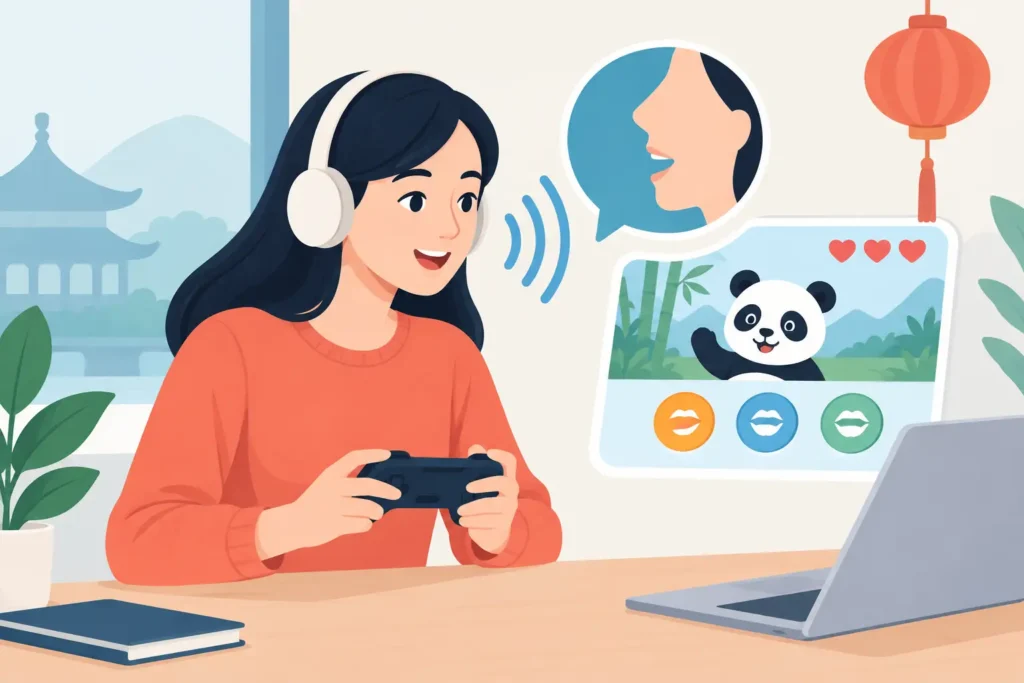
A Mandarin learner can recognize hundreds of characters and still freeze on a basic phrase because one tone lands wrong. That is the pronunciation gap: knowing what you want to say is not the same as being able to hear, produce, and adjust the sounds in real time. How games improve Mandarin pronunciation comes down to a powerful shift in practice design. Instead of treating sound drills as a test you endure, a well-built game turns them into decisions, feedback loops, and small wins worth chasing.
For learners who are tired of repeating syllables into a void, that matters. Mandarin pronunciation needs attention, repetition, and correction. Games can supply all three without making every session feel like homework.
How Games Improve Mandarin Pronunciation
Mandarin is not difficult because it is mysterious. It is difficult because several sound systems must work together under pressure. Learners need to distinguish consonants such as j, q, and x; hear the difference between final sounds such as -an and -ang; use tone contours accurately; and keep those sounds clear when words are placed in a fast, meaningful sentence.
Traditional drills can isolate each challenge, which is useful. But isolation has a cost. A learner may pronounce mā, má, mǎ, and mà correctly after a prompt, then lose the contrast in conversation. Games close part of that gap by asking players to react repeatedly to sounds while pursuing a goal. The sound is no longer an abstract item on a worksheet. It determines what happens next.
A tone-identification challenge, for example, can ask a player to match an audio cue to the correct meaning before a timer runs out. A dialogue game can require the player to select or speak the phrase that persuades an in-game character. The reward is not merely a green checkmark. It is progress, a solved puzzle, a completed mission, or a better score. That context gives pronunciation practice stakes without making a mistake feel socially expensive.
Pronunciation Needs a Fast Feedback Loop
The biggest advantage of interactive practice is frequency. Pronunciation improves through a loop: hear a contrast, make a choice or produce a sound, receive feedback, then try again before the mistake settles in. A game can run that loop dozens of times in a few minutes.
The strongest language games make feedback specific. “Incorrect” is not enough. If a learner confuses zh and z, or hears third tone as fourth tone, the system should make the contrast noticeable and bring it back at the right moment. Visual tone contours, clear recordings from native speakers, slowed playback, and side-by-side minimal pairs can help players connect what they hear with what their voice needs to do.
Immediate feedback is especially valuable for tones. English speakers often treat pitch as emotion or emphasis. In Mandarin, pitch movement can change a word’s meaning. A game can train this distinction through rapid listening rounds before it asks for speech production. That order matters. Learners cannot reliably produce a contrast they cannot yet hear.
Listening is gameplay, not a warm-up
Good pronunciation instruction begins with perception. Before a player can say qīng and qíng differently, they need to notice the acoustic features that separate them. Before they can use the third tone naturally, they need repeated exposure to its shape in real phrases, including tone changes that occur in connected speech.
Games are unusually good at making this repetition feel varied. The same sound contrast can appear as a memory match, a rhythm challenge, a branching conversation, or a quick-response puzzle. Variation keeps attention high while preserving the core learning target. It also reduces a common problem with flashcard-only study: learners remember the card’s layout or sequence rather than the sound itself.
That does not mean every mini-game teaches equally well. A points system pasted onto random audio clips is still random audio practice. The mechanic must force the learner to listen for the sound feature that matters. If winning does not depend on hearing tones, initials, finals, or word stress accurately, the game may be entertaining without improving pronunciation.
Repetition Works Better When It Has a Purpose
Rote repetition is not useless. It is simply hard to sustain when nothing changes. Games make repetition more durable by placing it inside goals, challenges, and visible progress. A player may revisit a pronunciation pattern because it helps them protect a streak, upgrade an ability, solve a puzzle, or complete a dialogue path.
That motivation is not a trick. Attention is part of learning. When players care about the next outcome, they listen more closely, take another attempt, and stay with a difficult pattern longer than they might in a static drill.
The best systems also space repetition instead of forcing 20 identical attempts in a row. A troublesome tone pair might return later in a different word, then again inside a sentence. This helps learners build flexible recall rather than a narrow, memorized response. Mandarin pronunciation becomes more usable when the learner can recognize a sound across speakers, speeds, and contexts.
For an educational game studio such as Riot Shield Games, this is the standard worth aiming for: real game design paired with intentional learning architecture. Fun should not distract from the skill. It should create more meaningful chances to practice it.
Low-Stakes Speaking Builds Real Confidence
Speaking is where many learners hesitate. They may worry that a wrong tone will sound embarrassing, that they will not be understood, or that they will be corrected in front of others. Those concerns are normal, but they can limit the number of attempts a learner is willing to make.
A game creates a private rehearsal space. Players can record a phrase, compare it with a model, retry it, and improve before using it with a teacher, tutor, classmate, or language partner. That lowers the emotional cost of error while preserving the usefulness of correction.
Speech recognition can help here, but it should be treated carefully. Automated scoring is useful for prompting extra attempts and catching broad differences in timing, syllables, or tone. It is not a perfect judge of every accent or every valid pronunciation. A good learning experience explains what the player should listen for rather than presenting a score as unquestionable truth.
Games can also build fluency by moving from single syllables to meaningful chunks. Start with tone recognition, then practice words, then short phrases, then responses in a simulated conversation. This progression respects how pronunciation actually develops. Perfect isolated tones are not the final boss. Clear communication in context is.
What a Strong Mandarin Pronunciation Game Includes
Not every language game deserves to be called a pronunciation tool. Look for design choices that connect play directly to sound learning:
- Native-speaker audio from more than one voice, so learners do not become dependent on a single recording.
- Activities that train both discrimination and production, since listening and speaking reinforce each other.
- Feedback that identifies the relevant sound contrast instead of only marking an answer right or wrong.
- Spaced review that brings difficult sounds back over time and in new contexts.
- Meaningful phrases and scenarios, so tones are learned as communication rather than isolated sound effects.
There is also a trade-off between speed and depth. Fast rounds are excellent for ear training and motivation, but they can encourage guessing if every prompt is rushed. Slower practice is better for comparing recordings, studying mouth position, and noticing tone movement. The most effective experience uses both: quick challenges to build automatic recognition, followed by focused moments where players can listen, imitate, and adjust.
Play Is Practice When the Design Is Intentional
Games will not replace real conversations with Mandarin speakers. Learners still benefit from live feedback, cultural context, and the unpredictability of human interaction. But games can make that next conversation far less intimidating by giving learners a high-volume practice arena before the stakes are real.
The goal is not to turn language learning into empty screen time. It is to make screen time earn its place. When a game asks players to listen carefully, speak often, notice errors, and return to difficult sounds with fresh motivation, it makes pronunciation practice more frequent and more human.
Next time a tone pattern keeps slipping away, do not just repeat it louder. Put it into a challenge you want to beat, listen for one specific contrast, and give yourself permission to retry. That is how practice starts feeling less like a correction and more like progress.