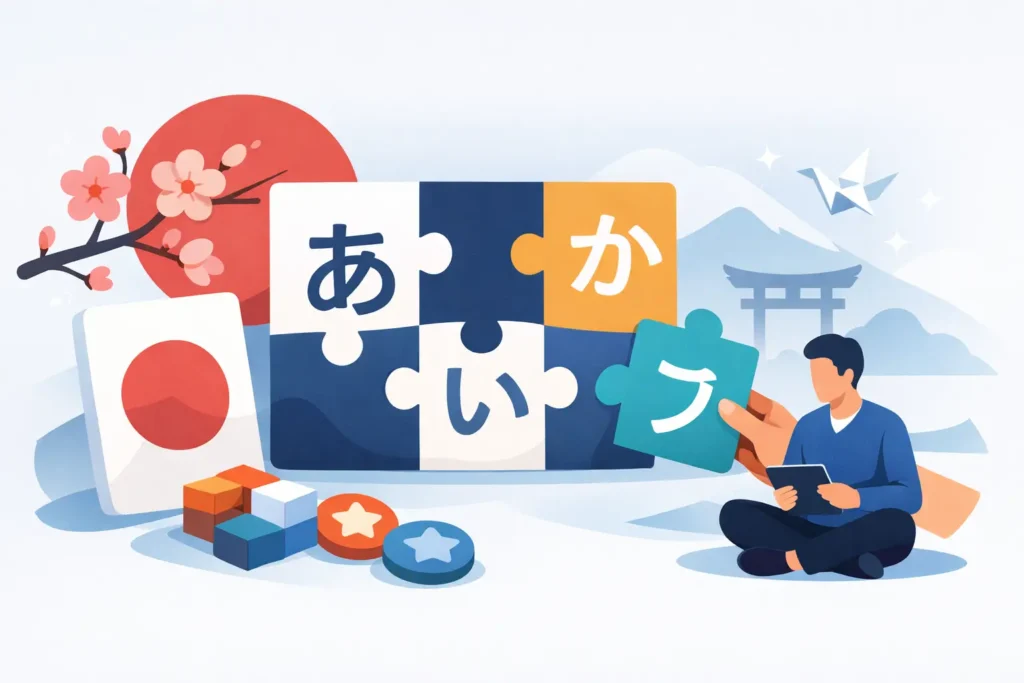
A hiragana chart can feel deceptively small. There are only 46 basic characters, yet staring at rows of あ, か, さ, and た rarely creates the instant recognition you need to read real Japanese. The problem is not that learners lack discipline. It is that flashcard-first study often asks the brain to memorize symbols without giving those symbols a job to do. When you learn hiragana through puzzle games, every character becomes part of a decision, a pattern, a goal, or a win.
That shift matters. Reading Japanese is not a quiz where you calmly choose an answer from four options. It is fast visual recognition under changing conditions. Good puzzle design trains that skill through repeated retrieval, not passive exposure. You see ぬ, connect it to nu, make a move, and keep playing. The learning loop is short enough to stay fun and demanding enough to build memory.
Why Puzzle Games Fit Hiragana So Well
Hiragana is a phonetic writing system, which makes it wonderfully learnable and surprisingly easy to mix up at first. Some characters have similar visual features. Others are easy to recognize in isolation but disappear from memory when they appear in a word. A learner may know ね during a review session, then hesitate when it appears beside unfamiliar symbols at game speed.
Puzzle games address that gap because they make recognition active. Instead of being told that ね is ne, players must identify it to clear a tile, complete a chain, solve a word, or avoid losing momentum. The character is no longer an abstract fact. It is useful information.
This is where game-based learning earns its place beside more conventional study. A good game can create high-frequency repetition without feeling like repetition. It can adjust difficulty, revisit weak characters, and reward accurate recall with visible progress. The best version does not hide the educational purpose behind flashy effects. It turns the learning objective into the core mechanic.
That is the standard Riot Shield Games believes educational games should meet: real play, real knowledge, and a system where getting better at the game means getting better at the skill.
What a Hiragana Puzzle Game Should Actually Train
Not every game with Japanese characters on the screen will help you read. Some are entertaining introductions, but they may rely on matching colors, positions, or memorized answer patterns rather than character recognition. A game is doing serious instructional work when its mechanics repeatedly require you to connect the written form, sound, and eventually meaning or vocabulary context.
Recognition comes before speed
At the beginning, your job is simple: see み and know it is mi. You do not need to race. You need clean recognition across the full basic set, including the characters that tend to blur together in a beginner’s memory.
Strong puzzle games introduce a limited character pool, then remix it often. That prevents you from remembering where an answer sits on the screen instead of what it is. If you can only identify り because it always appears in the upper-left tile, the game is testing placement memory, not hiragana.
Recall is where learning gets durable
Recognition asks, “Do I know this when I see it?” Recall asks, “Can I produce the sound without a prompt?” Both matter.
A well-designed progression moves from supported matching to less supported challenges. Early rounds might pair す with su. Later rounds might ask you to select す after hearing or seeing su in romaji. Eventually, the game can present a short hiragana word and ask you to parse it without leaning on English letters at all.
This gradual removal of support is more effective than throwing beginners into a full chart and hoping repetition sticks. Difficulty should rise because your skill rises, not because the interface becomes confusing.
Discrimination prevents look-alike mistakes
Hiragana has characters that deserve deliberate practice. さ and ち, ぬ and め, れ and ね, and あ and お can produce hesitation depending on the font and a learner’s visual habits. Puzzle games are especially good at targeting these trouble spots.
The useful challenge is not merely seeing a character again. It is choosing correctly between similar characters under a little pressure. A short timed round can make the difference between vague familiarity and reliable reading obvious. The goal is not stress. The goal is to make your attention sharper.
How to Learn Hiragana Through Puzzle Games Without Stalling
Puzzle games work best as a focused practice system, not as a background distraction. Fifteen engaged minutes can teach more than an hour of half-watching tutorials, but only if you play with a clear progression in mind.
Start by learning the basic gojūon set before worrying about every variation. Build confidence with the core vowels, then the k, s, t, n, h, m, y, r, and w rows. Do not wait for perfection before moving forward, but do not overload your session with every character at once. Most players learn faster when new material arrives in small clusters and older material keeps returning.
As you play, say the sounds aloud when possible. This adds an audio layer to the visual decision. When you identify た as ta, your eyes, memory, and voice are working together. It may feel slower in the first few sessions. That is fine. Speed is a result of accurate repetition, not something you force on day one.
After a session, spend two minutes testing yourself away from the game. Write a few characters from memory, read a short set of syllables, or mentally sound out a word you encountered. This small transfer step reveals whether you learned the character or only learned the level.
A practical weekly rhythm looks like this: use puzzle play for frequent recall practice, reserve a few minutes for handwriting and pronunciation, then read simple hiragana words when you are ready. The game supplies motivation and repetition. The short offline check makes the knowledge portable.
Choose Mechanics That Make the Alphabet Matter
The most effective hiragana games make character knowledge necessary for success. Word-building puzzles, tile-matching challenges based on sounds, grid searches, falling-block systems, and logic puzzles can all work. The genre matters less than the learning loop.
Look for games that vary prompts. If every challenge asks you to match kana to romaji, you may become excellent at that one format while remaining dependent on the alphabet. Variety pushes you toward genuine reading: kana-to-sound, sound-to-kana, kana-to-kana word building, and mixed review rounds all reinforce different parts of the skill.
Feedback also matters. Immediate correction is useful, but it should teach rather than interrupt the flow. If you miss そ, the game should bring it back soon in a different context. A score alone tells you that you were wrong. Smart repetition gives you another chance to become right.
Progression is the final test. A game should not keep you farming easy vowel rounds forever because success feels good. It should gradually introduce mixed rows, similar-looking characters, voiced sounds such as が and ぱ, contracted sounds such as きゃ, and real vocabulary. If a system never moves beyond isolated symbols, it can help with entry-level recognition but will not carry you far into reading.
The Trade-Off: Fun Is Not Automatically Learning
Games can make study more appealing, but they are not magic. A puzzle game with weak instructional design may reward quick tapping, lucky guesses, or visual habits that do not transfer beyond the app. Conversely, a highly structured drill may teach efficiently but be so dull that most learners quit before the gains compound.
The answer is not to choose fun over rigor or rigor over fun. It is to expect both. The right game should make you want one more round while quietly demanding that you read, remember, and decide.
It also depends on your goal. If you are preparing for a trip and want to recognize signs and basic menu words, puzzle practice can build a fast foundation. If you plan to read manga, take a Japanese class, or pursue fluency, hiragana games are your first system, not your entire curriculum. You will still need vocabulary, grammar, listening, and consistent exposure to real Japanese.
Turn Every Win Into Reading Confidence
Track more than high scores. Notice which characters still make you pause, which sounds you confuse, and whether you can read a new sequence without romaji underneath. Those are the milestones that matter.
When a character stops being a shape you decode and becomes a sound you simply know, the system is working. Keep playing until あいうえお is no longer a chart to memorize but the beginning of a language you can actually read. That is when your screen time starts paying you back.