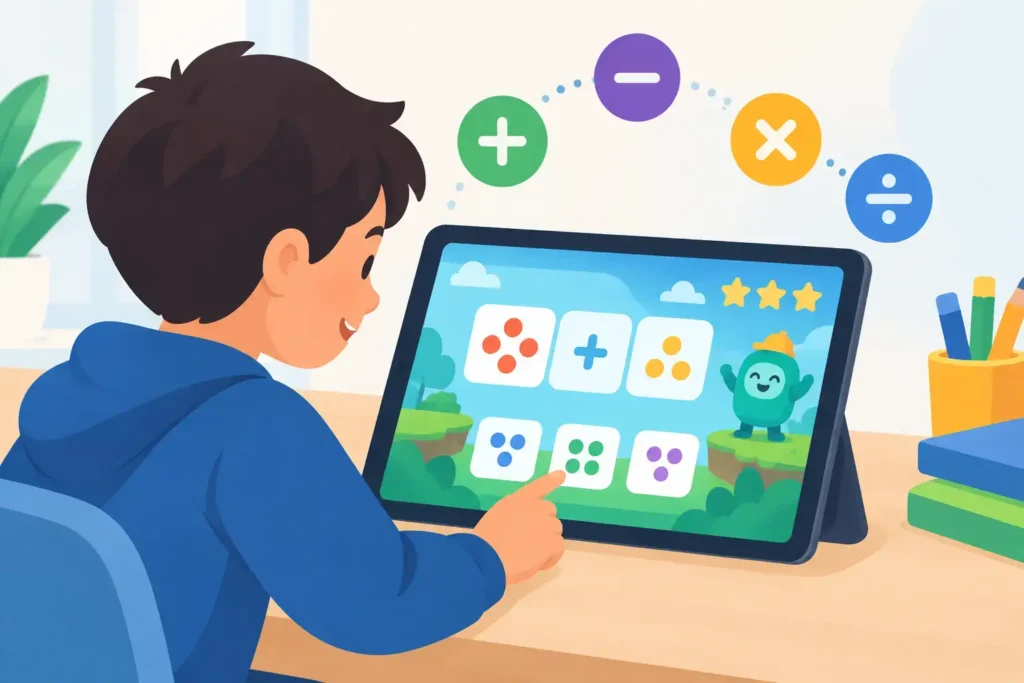
A player trying to buy the right upgrade before a boss fight is not thinking, “Time for a math worksheet.” They are comparing costs, estimating payoff, and making a decision under pressure. That is the core answer to how do games teach math: they make mathematical thinking useful inside a goal players genuinely care about.
A good educational game does not disguise a quiz with bright colors and call it play. It builds the math into the decisions, systems, and feedback loops that make the game worth playing. The player learns because better reasoning creates better outcomes. Play. Learn. Level Up.
How Do Games Teach Math Through Play?
Games teach math best when numbers are not an interruption. They are part of the game’s language.
In a strategy game, players may calculate whether limited resources should go toward defense now or a more valuable upgrade later. In a puzzle game, they identify patterns, test rules, and revise a plan after a failed move. In a racing or action game, they may develop an intuitive sense of rate, distance, timing, and spatial relationships. The learning is active because the player has a reason to pay attention.
That distinction matters. Passive exposure to a concept can build familiarity, but familiarity is not the same as usable knowledge. Math becomes durable when players repeatedly make predictions, see what happens, and adjust their next move.
The strongest games create this loop:
- The player faces a meaningful problem.
- They use a mathematical idea to make a choice.
- The game shows the consequence quickly.
- A new challenge asks them to use the idea again in a slightly different form.
That is practice with stakes, even if the stakes are virtual treasure, a higher score, or surviving one more round.
The Mechanics That Turn Numbers Into Skill
Not every game with points, coins, or a scoreboard teaches math. Numbers alone do not create learning. The mechanics need to require mathematical reasoning.
Patterns become tools, not trivia
Math is full of structure: sequences, relationships, symmetry, equivalence, and rules that repeat. Games are naturally good at presenting structure because they are systems of rules. A puzzle that asks players to spot the next move, optimize a path, or transform a board can develop pattern recognition without asking learners to memorize disconnected facts.
The key is variation. If players solve the identical problem over and over, they may learn a narrow trick. If the game changes the surface details while preserving the underlying concept, players have to recognize the structure itself. That is closer to real mathematical thinking.
Immediate feedback shortens the learning loop
A traditional assignment might return to a student days later with a score and a few marks in red. A well-designed game can respond in seconds. The player sees that an estimate was too low, a resource plan was inefficient, or a probability bet was risky.
Fast feedback is powerful because it connects a decision to its result while the reasoning is still fresh. It also makes mistakes less punishing. In a game, failure is often information: try a different route, change the strategy, and run the experiment again.
That does not mean every game should hand out answers instantly. Some productive struggle is necessary. If a hint appears before the player has time to think, the game replaces reasoning with tapping. The better design choice depends on the learner, the concept, and the difficulty of the task.
Repetition gains a purpose
Math fluency requires repetition. The problem is that repetition without meaning feels like labor. Games can make repeated practice feel purposeful by tying it to progression.
A player may need to compare fractions to craft an item efficiently, use multiplication to scale a build, or calculate percentages to choose the best deal in an in-game market. The same skill gets practiced many times, but each attempt supports a larger goal.
This is where game design can outperform a stack of flashcards. The reward is not just a correct answer. It is access to a new strategy, a solved challenge, a stronger character, or the satisfaction of seeing a plan work.
Math Learning Works When It Is Embedded, Not Bolted On
The phrase “learning game” can make some players picture a conventional lesson interrupted by a minigame. That approach has its place, especially for direct practice, but it rarely creates the sustained motivation of a real game.
A more ambitious approach starts with a question: what would make this mathematical idea necessary? If probability is the target, perhaps players must weigh uncertain outcomes before committing scarce resources. If ratios are the target, perhaps they are balancing ingredients, power systems, or competing unit types. If geometry is the target, perhaps spatial reasoning determines whether a structure holds, a route fits, or a defense succeeds.
When the concept and mechanic support each other, the player cannot separate the game from the learning. They are the same activity.
This is the design philosophy behind serious educational games, including the work Riot Shield Games pursues across language, STEM, finance, and climate learning. The standard should be higher than “educational enough.” The game should respect players’ intelligence and give them a reason to return after the novelty fades.
What Kinds of Math Can Games Teach?
Games can support a wide range of mathematical skills, but the best format depends on the learning goal.
Arithmetic fluency can fit fast-paced challenges where quick calculation improves performance. Fractions, ratios, and percentages work especially well in systems involving sharing, scaling, crafting, or trade-offs. Algebraic thinking emerges when players track changing variables and infer how one action affects another. Geometry and spatial reasoning fit building, navigation, rotation, and planning games. Probability becomes tangible in games that ask players to manage risk rather than merely recite odds.
Data literacy can also become more compelling in a game setting. Players can interpret charts, detect trends, compare outcomes, and decide which evidence should guide their next move. That is valuable far beyond a classroom. Real life is full of claims, percentages, forecasts, and financial choices competing for attention.
Still, games are not equally effective for every objective. A game can build intuition about probability without guaranteeing that a learner can explain formal probability notation. It can make fractions feel useful while still leaving gaps in procedural fluency. For that reason, the strongest learning experiences often combine gameplay with brief reflection, targeted practice, or discussion.
The Difference Between Engagement and Learning
A game can be exciting and still teach very little. It can also be academically accurate and still fail because no one wants to play it twice. Great educational design has to solve both problems.
Engagement matters because attention is the doorway to practice. But engagement is not proof of mastery. A player may succeed through trial and error, visual cues, or memorizing one level’s layout. Designers and educators need evidence that the player is using the intended idea and can apply it beyond a single challenge.
That means asking better questions during development. Does the mechanic require the target skill, or can players bypass it? Does success improve when their reasoning improves? Are later challenges varied enough to test transfer? Can the game identify where a player is struggling and provide useful support without taking over?
Measurement should serve the learner, not reduce learning to a dashboard. A score is helpful when it tells a player what to improve next. It is less useful when it simply labels them as good or bad at math.
Why This Matters Beyond the Classroom
Many people carry unnecessary baggage around math. They remember speed drills, public mistakes, or the feeling that there was only one acceptable way to think. Games can change the emotional experience of practicing. They create space for experimentation, retries, and curiosity.
That shift is not trivial. A learner who believes math is a fixed talent will often avoid the very practice that builds skill. A player who sees a hard system as something to decode is more likely to persist. The game does not erase difficulty. It gives difficulty a purpose.
The best next step is simple: choose games where numbers affect real decisions, then notice what you are predicting, comparing, and revising as you play. When math becomes part of the mission, practice stops feeling like a detour and starts feeling like progress.