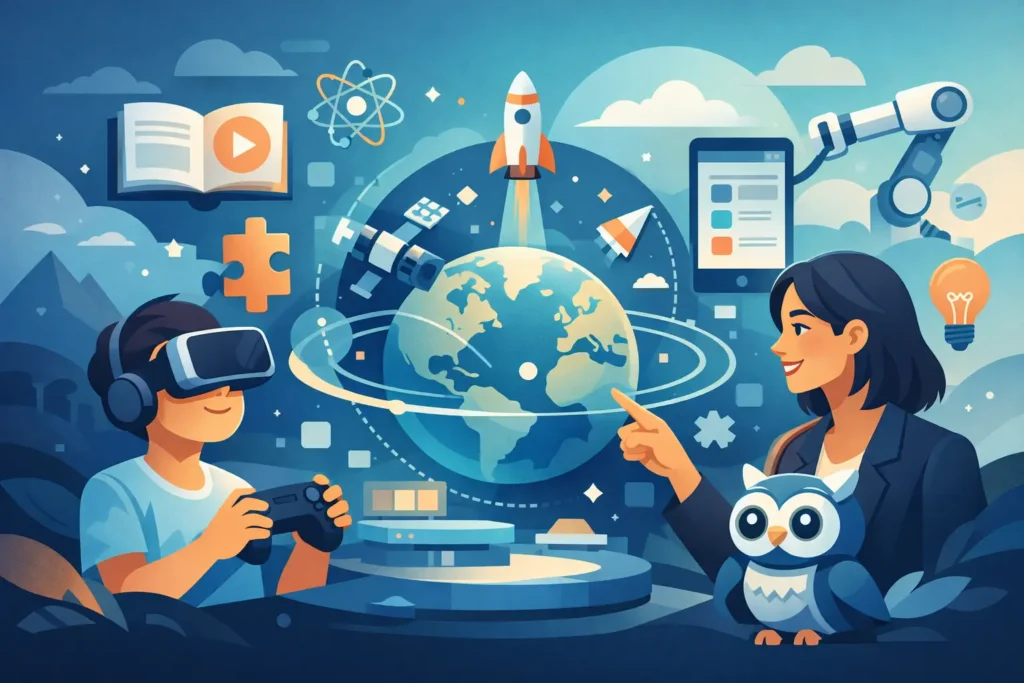
A few years ago, “educational game” still sounded like a compromise. You played it because a teacher assigned it, a parent approved it, or you felt guilty enough to swap out one hour of scrolling for something useful. That equation is breaking down fast. Educational games 2026 are shaping up to be something much more interesting: games people choose because the play is strong and the learning actually sticks.
That shift matters. Players are getting better at spotting shallow reward loops dressed up as education, and they are just as quick to reject “learning products” that forget to be games. The next wave will belong to titles that respect both sides of the equation. If the mechanics are weak, players leave. If the learning design is thin, the game becomes a sugar rush with no lasting value. The bar is finally where it should have been all along.
What educational games 2026 will need to get right
The biggest change is not just better graphics, bigger budgets, or more platforms. It is design maturity. Educational games are starting to catch up to what great entertainment games have always known: motivation comes from agency, tension, feedback, progression, and identity.
In 2026, the strongest titles will teach through action rather than interruption. That means fewer quiz screens stapled onto gameplay and more systems where knowledge is the tool that lets you win. If you are learning a language, the game should make comprehension tactically useful. If you are learning finance, resource decisions should carry real strategic weight. If you are learning climate science, systems thinking should shape the world you are navigating.
That sounds obvious, but it is still rare. Too many products still separate the “fun part” from the “learning part,” which teaches players to endure one in order to reach the other. The better model is integration. When learning is embedded in the core loop, progress feels earned instead of assigned.
The old edtech formula is running out of steam
A lot of study apps have done useful work, especially for habit formation and repetition. But many of them hit the same ceiling. Streaks can motivate you to return, but they cannot always make the material meaningful. Flashcards can improve recall, but they often struggle to create context. Mini-games can keep things light, but light is not the same as deep.
That is why players are looking for more than gamification. They want gameplay with substance. There is a real difference between adding points to a worksheet and building a system where learning changes what you can perceive, decide, and achieve.
This is where educational games have a serious opening in 2026. The audience has matured. Teens and adults who grew up with polished indie games, strategy games, RPGs, and live-service systems are not impressed by shallow mechanics. They expect feedback that matters, challenge curves that make sense, and progression that feels personal. If a learning game cannot meet that standard, it will feel outdated immediately.
The genres most likely to lead educational games 2026
Language learning is especially well positioned because it fits naturally into game logic. Vocabulary, pattern recognition, dialogue choices, spatial memory, and repeated exposure all work inside good game systems. A puzzle game can teach recognition and retention. An RPG can make comprehension feel like power. A social or narrative game can turn language into identity and consequence.
STEM is another strong fit, but only when the design avoids turning science into homework with animations. The best STEM games use experimentation, prediction, and systems thinking. A player should feel the logic of a concept before they are asked to explain it. Building, simulating, optimizing, and troubleshooting all create natural opportunities for learning that does not feel forced.
Personal finance is quietly becoming one of the most important categories. Not because it is trendy, but because the need is obvious. Players want useful skills, and financial literacy has immediate real-world payoff. The challenge is tone. If the game feels preachy, players tune out. If it is too simplified, it becomes fantasy economics. The smart middle ground is to make trade-offs legible. Budgeting, risk, delayed rewards, and opportunity cost all become more memorable when they shape outcomes you care about.
VR and mixed-reality educational games also have real potential in 2026, especially for embodied learning. Climate literacy, lab simulation, environmental systems, and historical reconstruction all benefit from presence. But there is a trade-off here. Immersion can amplify learning, yet hardware friction still limits reach. The best VR education titles will likely be the ones with a clear reason to exist in 3D, not just a standard lesson transplanted into a headset.
Better learning design is becoming a competitive advantage
This is where the category gets serious. The winners in educational games 2026 will not just be the teams with the brightest art direction or cleverest trailers. They will be the teams that understand instructional design well enough to make it invisible.
Players should not feel like they are being marched through a curriculum. They should feel like the game is reading their strengths, exposing their blind spots, and adjusting pressure in ways that keep them engaged. That means smarter scaffolding, cleaner feedback, and stronger alignment between mechanic and outcome.
Adaptive systems will help, but adaptation alone is not enough. A game can personalize difficulty and still teach poorly if the underlying tasks are disconnected from meaningful play. The deeper win is relevance. Every challenge should answer the player’s silent question: why does this matter right now?
Academic credibility will matter more, too. Not as a marketing ornament, but as a trust signal. Parents, educators, and serious learners are getting more selective. They want proof that a game’s learning claims are grounded in something stronger than vibes. Studios that combine real curriculum thinking with actual game craft will stand apart quickly.
Why players are finally ready for this category
The appetite is already there. People want screen time that gives something back. They want entertainment that sharpens memory, builds skill, expands language, or makes a complex topic feel graspable. They are not asking games to stop being fun. They are asking them to do more.
That is a powerful demand signal. It means educational games no longer have to sell themselves as worthy substitutes for “real games.” They can compete on ambition. A great learning game can offer mastery, challenge, surprise, and identity formation just as effectively as any other genre. In some cases, it can offer more, because progress extends beyond the game itself.
For students and young professionals, that means skills with immediate utility. For lifelong learners, it means a better reason to stay engaged. For parents and educators, it means a category worth taking seriously instead of tolerating. And for developers, it means the standard has risen in a way that is healthy. Build something shallow, and players will know. Build something sharp, and they will come back for reasons that go beyond habit.
What to look for before you trust the hype
Not every game that claims to teach will deserve attention in 2026. A few signs usually separate the serious work from the marketing spin.
First, the mechanic should carry the lesson. If the learning lives only in pop-ups, cutscenes, or post-level trivia, the design is probably doing too little. Second, progression should reflect actual skill growth, not just time served. Third, the subject matter should hold up under scrutiny. If a game promises language acquisition, STEM fluency, or financial literacy, the learning model needs to be coherent.
And finally, the game should respect the player. That means no talking down, no fake challenge, and no assumption that educational content gets a free pass on quality. The strongest studios in this space understand a simple truth: if a game is going to leave you smarter than when you started, it first has to deserve your attention.
That is the real opportunity ahead. Educational games do not need to imitate school, and they do not need to apologize for being ambitious. They need to build worlds, systems, and challenges where learning is the edge that lets you play better. If 2026 delivers more of that, this category will stop feeling like a niche and start looking like the future of meaningful play.
Play should not be the break from learning. At its best, play is how learning becomes memorable enough to keep.