Imagine, if you will, writing a book in a language that had only one word for each emotion. Or was written almost like a technical document. Imagine also a movie that was filmed like high schoolers with a video camera. No editing, no multiple camera angles. The issue both of these have would be a lack of vocabulary. And I don’t mean SAT vocabulary but rather the diversity and nuance of actions shown by words or visual storytelling. I will say that modern video games grew out of a poor vocabulary – a language that is lacking.
Let’s start with some early games, like Pitfall. And anything I say about games should not be interpreted as a criticism. I know first hand how hard it is to create anything that works. But the game is a product of its time – blocky graphics, bumbling controls, and a nonsensical plot that only serves as weak scaffolding for gameplay. And as such, it does some nonsensical things, like having the character fall into a bottomless pit. You ever think about how a bottomless pit actually kills? The falling person would die of starvation. Definitely not instant.
But let’s take a quick aside. Let’s talk about books, movies, video games, and anything that hints at a narrative. What are the elements of a narrative? I’m no scholar on literature or storytelling, but I think it’s fair to say they include plot and characters. I think this covers novels and movies and perhaps some short stories and other traditional narrative structures. I would then say that video games traditionally add another “axis” to the plot and character axes: gameplay. In fact, some games can just be gameplay reliant. Take Tetris or Kanji Drop – they contain no characters or plot! Some games, like Puzzle Fighter or Kirby’s Avalanche, can introduce characters and a meager plot, but the gameplay is still the core driver.
And so, I want to take a page from programming and ask, “What if books, movies, AND video games all derive from a common ‘Super Narrative’?” That is, what if there is an abstract hypothetical structure that when made real, focuses on some of its “axes” to create that particular narrative? That is, the Super Narrative would contain ALL the elements that books, movies, video games, and more encompass: words, action, plot, editing, angles, action, interactivity, music, and more? We cannot fathom something having all of these things at once – it is like trying to perceive the 26th dimension. But to consider a first-principles study of narratives is an important field as it can give insight and structure to seemingly disparate concepts.
So, what does this imply? That video games need to be more like books or movies? No! I’d say almost the opposite – they need to understand where they are. I’ve already established that they have an extra “axis” of gameplay. That is, a creator must balance gameplay along with story and characters when making a game with a plot, like a game in the Zelda series. But should the storytelling be like movies and books? Let’s think about this… I want to bring up something in movies (and some books) that is treated wildly different in video games: A montage. Think in the Rocky movie where he is working out in the Russian tundra and getting stronger. Rocky carries logs, chops wood, etc. in order to build up his stamina, endurance, and strength to take down Ivan Drago on his home soil. And why a montage showing short scenes stitched together over a soundtrack? Because no movie watcher wants to sit and watch someone chop wood for 5 hours. However, I would say that video games are extended montages. When a player fights enemies, goes through a dungeon, has a drawn out battle with a boss, etc. it is essentially filling the same narrative element as a montage. In this way, I argue that video games are basically extended montages with some dialogue and character development placed in between. In terms of percentages of time of experience, it’s almost reversed from movies: more time on the montage and less on the dialogue and character interaction.
And one more aside – let’s also consider the differences between a simulation and a game. Imagine Super Mario Bros. but without enemies, pits, score, timers, etc. It’s basically a “weird physics” simulation – Mario jumps, breaks bricks, etc. But having a plot of sorts – get to the flagpole, defeat bowser, etc. with stakes makes it a game and adds the fun element. After all, a video game without fun is like a rocket ship that doesn’t fly. But also consider some simulations or simulators that are fun – SimCity, Minecraft, etc. Sometimes just having a “sandbox” is fun in its own way. I had endless joy playing with a big bucket of Legos as a kid.
So where does this leave us? Well, I would say that video game narrative design should consider balancing the three axes I mentioned: characters, plot, and gameplay (not necessarily in that order). I think it should be re-thought from the ground up and that video game tropes – bottomless pits, instant kill spikes, nonsensically architectured palaces or dungeons – should be reconsidered, despite being commonplace. I made a conscious design choice to leave enemies in place after they are defeated, even on reload. Why? Because in reality, things don’t just disappear. I also will not have bottomless pits or anything physically nonsensical. The world needs some causality to it and allow itself to be questioned on a deep level. Most video games rely heavily on suspension of disbelief – you just don’t think about things. Why and how does a mushroom make Mario big and why and how does a fire flower allow him to shoot fireballs? How come he never runs out? Reality has conservation laws, like the conservation of matter-energy, but video games tend to not.
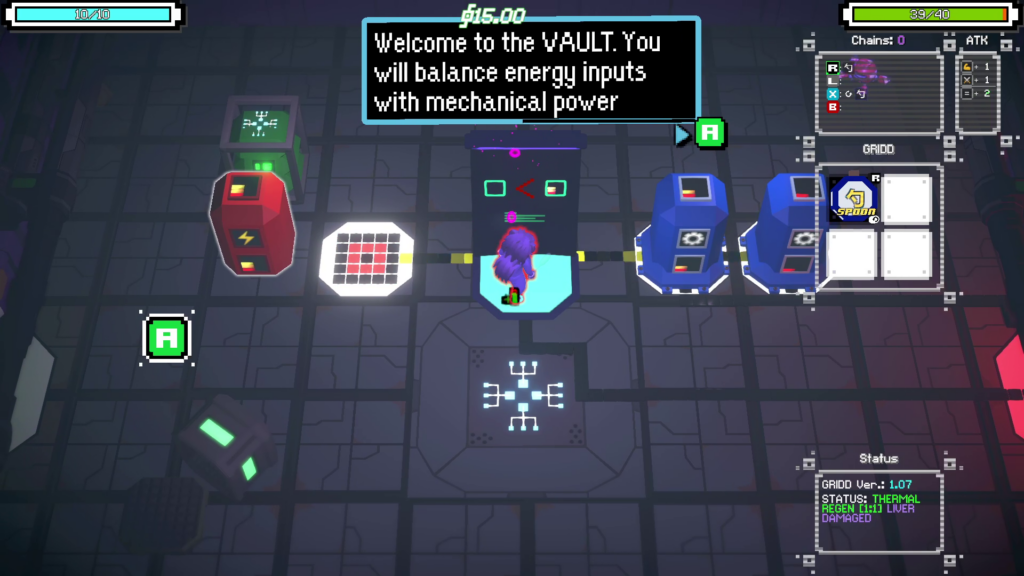
Finally, I want to add that I have used this structure to create The Adventure of Spyke but added one more axis: learning concepts. That’s right, the 4th axis, after gameplay, plot, and characters, in that order, is learning concepts. This is what I feel is the core unique feature of The Adventure of Spyke. The player will learn things but not because they are the core focus of the game. The game’s kernel is still rooted in traditional gameplay features. I feel the learning concepts are best expressed if they are integral to the action and in the guise of a puzzle, such as the energy and motor balancing. I feel things like learning kanji are best done through constant exposure and that’s part of the reason they are at the core of the inventory system. The puzzles end up helping to push the plot forward and are developed to sit in the game’s world. I will utilize the VR within the game as it can be an escape to a world without normal conservation laws or even causality and serve as a practice area with fewer adverse consequences while bootstrapping learning. In this way, the game in its entirety can be a sort of practicum for concepts that pose a more engaging way to learn concepts: an interactive practicum. Concepts are learned interactively and trial and error are welcomed. The player is rewarded rather immediately for understanding a concept so there’s less of the “Why do I have to learn this?” type of questions. (I will say that it is important to know some things to have a base level of understanding of the world we inhabit. My knowledge of math, though utilized less and less, gives me a vocabulary to understand the world. My knowledge of biology helps me understand medicine and disease. Knowing many things makes learning new things easier!)
So thank you for reading and please check out The Adventure of Spyke if you haven’t yet. You can play the demo for free right now on Steam and Itch. https://riotshieldgames.com/spyke