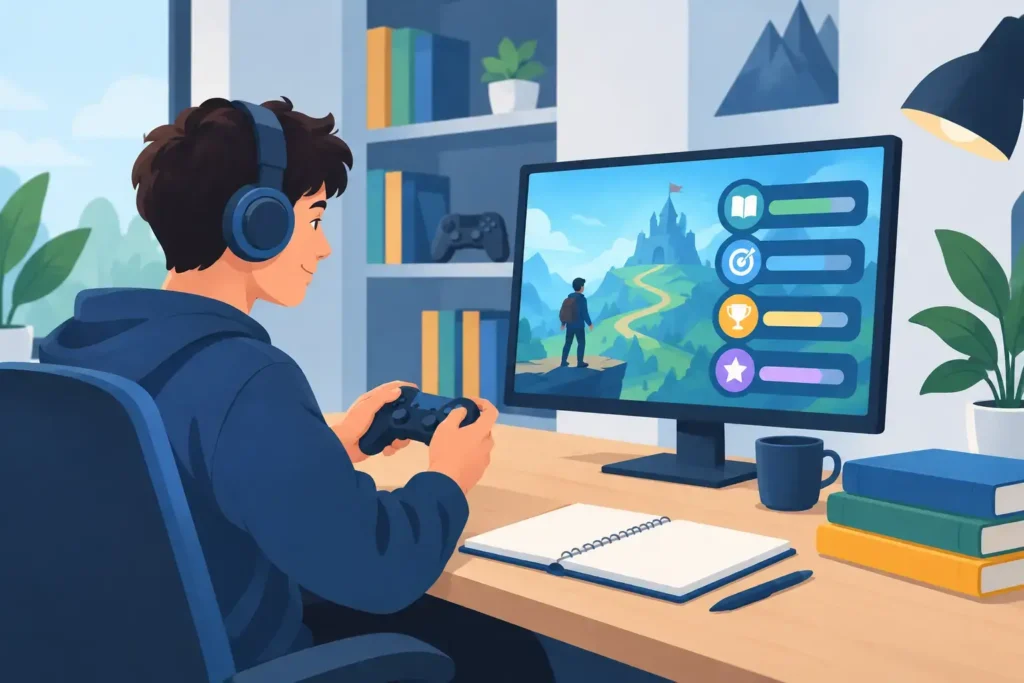
Your study plan does not need another color-coded spreadsheet if the real problem is that you never want to open it. The goal is to build study habits through gaming by borrowing what games do best: give players a clear next move, make effort visible, and turn small wins into a reason to come back tomorrow.
That is not a call to disguise worksheets with cartoon badges. Good game-based learning respects both sides of the equation. It has to be enjoyable enough to earn attention and rigorous enough to make that attention count. When the loop is designed well, practice stops feeling like a punishment you negotiate with yourself and starts feeling like progress you can feel.
Why Games Can Create Repeatable Study Behavior
Games are unusually good at solving the problem that defeats most study routines: the gap between intention and action. A student may care deeply about passing a class, speaking Japanese, or finally understanding personal finance. But those distant goals do little at 8:30 p.m. when a textbook feels heavy and a phone offers instant stimulation.
A well-designed game shrinks that distance. It presents a concrete objective, such as solving the next puzzle, surviving the next encounter, or completing a short quest. It gives immediate feedback on the result. Then it shows what changed because of the effort: a new skill, a higher score, a stronger character, a revealed piece of the world.
Study habits need those same ingredients. Motivation is useful, but it is unreliable. A repeatable system is stronger. If opening a learning activity always reveals a manageable challenge and a visible path forward, starting requires less willpower.
The key word is meaningful. Points alone do not create learning. A score should represent something real: words recalled without help, a math concept applied correctly, a budget decision understood, or a climate system explained in context. The reward works because the player has evidence of growing capability.
Build Study Habits Through Gaming With a Strong Loop
The best learning games are not built around one giant reward at the end of a chapter. They use a loop that makes every session feel complete while still pulling the learner toward the next one.
Start With a Quest Small Enough to Begin
A vague instruction like “study chemistry” creates friction because it hides the first action. A game-like quest is specific: identify five reaction types, translate three dialogue lines, or solve one resource-management scenario.
Keep the first task short enough to feel almost too easy. Ten focused minutes can establish a habit better than an ambitious two-hour plan that collapses by Wednesday. This is not lowering the standard. It is engineering a reliable entry point. Once a player is moving, they are far more likely to continue.
Good quests also have a reason to exist inside a larger mission. Vocabulary becomes useful because it helps a character negotiate, investigate, or navigate a new environment. Percentages matter because they determine whether an in-game shop, investment, or strategy succeeds. Context gives isolated facts a job.
Make Progress Visible, Not Vague
Traditional studying often hides improvement. You can spend an hour rereading notes and finish with no clear sense of what you now know. Games solve this with progress bars, map completion, unlocked abilities, collections, and evolving challenges.
Use that principle carefully. Track mastery rather than mere time spent. A learner who recognizes a Mandarin word after four hints should not receive the same progress signal as one who recalls it accurately in a new sentence. The system should celebrate effort while distinguishing exposure from competence.
Visible progress is especially powerful for subjects with delayed payoff. Language fluency, financial confidence, and scientific literacy are built over hundreds of small moments. Seeing those moments accumulate turns a long climb into a series of completed levels.
Match Challenge to Skill
A game becomes boring when success is automatic and frustrating when failure feels inevitable. Learning works the same way. The sweet spot sits just beyond what a player can do comfortably, where attention is required but progress still feels possible.
That means the right experience changes as the learner improves. Early language practice may rely on recognition and repetition. Later, it should demand recall, word order, listening comprehension, and spontaneous use. Early STEM challenges may teach a rule directly; later ones should ask players to choose which rule applies under pressure.
Adaptive difficulty matters because it protects momentum. If a learner misses an answer, the useful response is not simply “wrong.” It is targeted feedback, another attempt, and a slightly clearer route back into the challenge.
Turn Subjects Into Playable Systems
Not every topic benefits from the same game mechanic. Matching the mechanic to the skill is where educational design becomes more than a layer of points on top of content.
Language learning thrives on repetition with variation. Puzzles, dialogue choices, memory challenges, and narrative consequences can repeatedly bring back vocabulary without making every encounter feel identical. The player is not just collecting words. They are using language to accomplish something.
STEM learning benefits from simulation, experimentation, and cause-and-effect systems. Rather than memorizing a formula in isolation, players can test it against a problem, see the outcome, revise their approach, and learn why one choice works better than another. Failure becomes information, not a verdict.
Personal finance is especially suited to strategic play because its lessons are about trade-offs. A player can feel the consequences of spending, saving, borrowing, investing, and planning within a safe fictional system. The point is not to promise easy answers. It is to let people practice judgment before real money is at stake.
Climate literacy can become more tangible through systems that show interdependence. Players can see how choices around energy, land, infrastructure, and consumption create ripple effects. A strong simulation makes complexity legible without pretending that complex problems have a single magic solution.
This is the standard Riot Shield Games pursues: gameplay with enough depth to stand on its own, paired with learning that leaves players genuinely smarter than when they started.
Avoid the Trap of Fake Progress
Gaming can support learning, but it can also create the illusion of learning. If a player advances by tapping quickly, guessing repeatedly, or exploiting a reward loop without thinking, the habit being built is not study. It is button pressing.
The solution is to require retrieval and application. Ask learners to produce an answer before showing it. Reintroduce material after time has passed. Change the setting so they must use the underlying idea rather than recognize a familiar screen. Let mistakes have consequences that invite reflection, not shame.
A useful test is simple: could the learner do something new with this knowledge outside the game? If a player can read an unfamiliar phrase, reason through a different science problem, or explain why a financial choice carries risk, the system is building transfer. If not, the game may be entertaining without being educational.
There is also a trade-off between streaks and autonomy. Daily streaks can help a habit take root, especially at the beginning. But they can become stressful if missing one day makes learners feel they have failed. Better systems reward return without treating rest, illness, or a demanding week as defeat. Consistency is about resuming the practice, not maintaining a perfect record forever.
Build a Study Session Players Want to Repeat
A practical game-based session can be short. Begin with a clear mission that takes five to ten minutes. Move into a challenge that requires recall or decision-making. End by showing what improved and teasing the next meaningful objective.
For example, a language learner might start by reviewing words that are close to being forgotten, use those words in a timed dialogue puzzle, then unlock a new scene that requires them tomorrow. A finance learner might examine a quick scenario, make a budget choice, see the consequences, and revisit that choice after new information appears. The loop is compact, but it contains action, feedback, adaptation, and anticipation.
The environment matters too. Remove easy exits when focus is the goal. Keep the device, game, and starting point ready. Decide in advance what counts as a completed session. When the first move is obvious, the habit has a fighting chance on low-energy days.
Let Play Make the Next Session Easier
The real win is not one productive night. It is building a relationship with learning that survives boredom, busy schedules, and the occasional wrong answer. Games can help because they teach a powerful lesson through experience: progress is made by showing up, trying a harder version, learning from feedback, and trying again.
Choose learning experiences that respect your intelligence, make effort visible, and give knowledge a purpose. When study feels like forward motion instead of a chore, returning tomorrow becomes the natural next move.