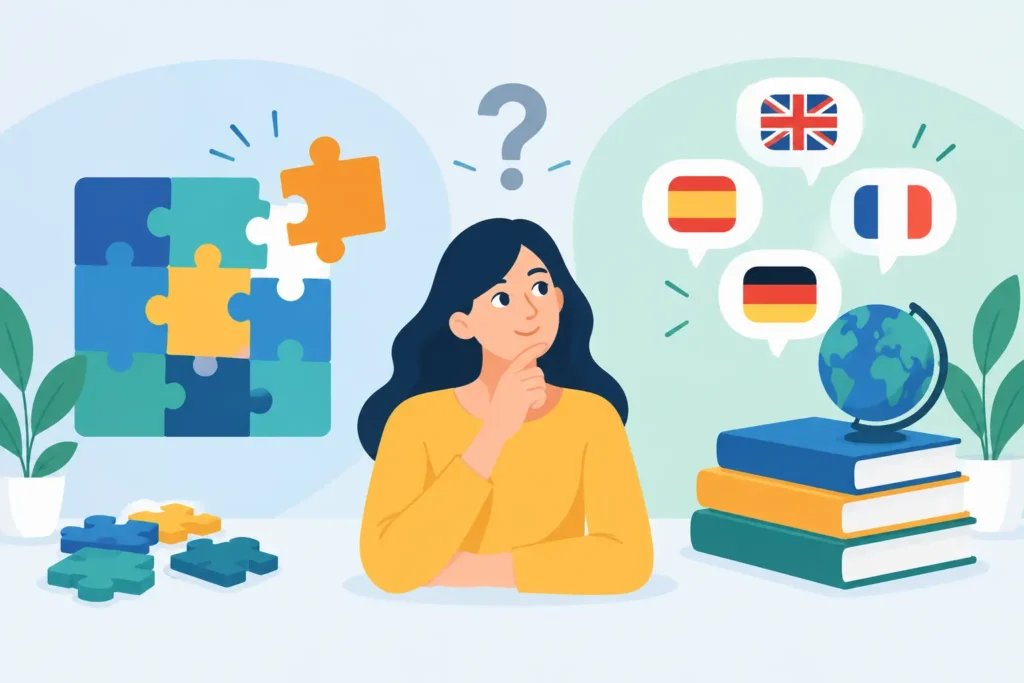
A language course can give you a perfectly organized plan, then ask you to find the energy to follow it after a long day. A good game attacks the same problem from another direction: it gives you a reason to come back. The real question behind puzzle games versus language courses is not which format looks more educational. It is which one keeps learners practicing long enough for knowledge to become usable.
For gamers and self-directed learners, that distinction matters. Language learning is not won by one heroic study session. It is built through thousands of small encounters with words, sounds, meanings, and choices. The best tool is the one that makes those encounters happen consistently.
Puzzle Games Versus Language Courses: The Real Difference
Language courses are designed around instruction. They introduce vocabulary, explain grammar, organize material by level, and often test whether you can recall what you studied. At their best, they provide a map: here is what to learn next, why the pattern works, and how each lesson connects to the last.
Puzzle games are designed around interaction. Instead of asking, “Can you remember this word?” a game can ask you to recognize a pattern under pressure, choose the right character to solve a challenge, or connect meaning to an action that moves you forward. Learning becomes part of the feedback loop, not a detour before the fun begins.
That difference changes motivation. Courses often rely on delayed rewards: study now, speak better later. Games create immediate rewards: solve this, advance now. Neither approach is automatically superior, but immediate feedback is powerful when a learner’s biggest obstacle is consistency.
There is also a difference in emotional framing. Traditional courses can make mistakes feel like evidence that you are behind. Well-designed games treat mistakes as information. You try, fail, adjust, and try again because the next attempt is already waiting. That is a healthier rhythm for beginners, especially learners who carry bad memories of language class.
Where Puzzle Games Have the Edge
The strongest case for learning through puzzle games is not that games make language effortless. They do not. The case is that games can make effort feel worthwhile.
A puzzle creates a meaningful problem. If solving it requires understanding a Japanese word, matching Mandarin vocabulary to context, or noticing a grammar pattern, the language is no longer a disconnected fact on a card. It is a tool with a purpose. That context can make recall stronger because the player remembers what the word helped them do.
Games also excel at repetition without the deadened feeling of repetition. A course may present the same item in a quiz several times. A game can bring it back through changing challenges, timing, spatial reasoning, collection goals, or escalating difficulty. The learner still gets retrieval practice, but the experience has variety and stakes.
This matters for habit formation. A five-minute game session is easy to begin. One completed level creates momentum. A streak, a new mechanic, or a nearly solved puzzle creates a reason to return tomorrow. For busy students and professionals, that pull can be more valuable than the most elegant syllabus they never open.
Riot Shield Games is built around this principle: gameplay should not merely decorate educational content. The mechanic itself should make knowledge useful. When players engage because the game is good, learning gets more repetitions than it would through obligation alone.
Engagement is not the same as distraction
There is a catch. A game can be engaging while teaching very little. If the player can win by ignoring the language, the language is just wallpaper. Points, animations, and collectibles do not create learning on their own.
Educational game design has to earn its claims. The target skill must be tied directly to player decisions. The game should give clear feedback, revisit material at useful intervals, and gradually demand more than recognition alone. A player who repeatedly identifies a word may build familiarity. A player who must use it accurately in varied contexts starts building command.
That is why the best learning games feel like games first but never let the learning become optional.
Where Language Courses Still Win
A course has advantages that a puzzle game should not pretend to replace. Structured instruction is especially useful when learners need clear explanations of grammar, pronunciation guidance, writing practice, or preparation for a formal exam. A skilled teacher can hear an error, explain why it happened, and adapt the next lesson in real time.
Courses are also better at covering a broad curriculum deliberately. A game may go deep on specific vocabulary sets or recognition skills, while a course can ensure that learners encounter listening, reading, speaking, grammar, and cultural context in a planned sequence. If your goal is professional fluency, academic credit, or a proficiency test, that structure matters.
Human interaction matters too. Speaking a new language with another person involves uncertainty, timing, accent variation, and social confidence. No solo puzzle can fully reproduce that experience. Conversation groups, tutors, and classroom partners create productive pressure that turns passive knowledge into communication.
The downside is that courses often demand more scheduling, more willpower, or more money. They can also move at a pace that is wrong for the individual learner. Fast learners may get bored; anxious learners may feel exposed; everyone can fall behind when life gets crowded. A course gives you a path, but it does not automatically give you momentum.
The Better Question: What Are You Trying to Build?
Choosing between games and courses depends on the job you need the tool to do. If you are starting from zero and want to create a daily learning habit, a language puzzle game can be an unusually strong entry point. It lowers the barrier to practice and makes early progress visible.
If you already know some basics but struggle to remember them, games can provide the volume of retrieval and pattern recognition that turns shaky knowledge into faster recall. They are especially useful for learners who enjoy systems, optimization, and the satisfaction of solving a hard problem.
If you need to speak with clients in six months, pass a placement exam, or write accurately in a professional setting, add structured instruction. You need explicit feedback and opportunities to produce the language, not just recognize it. The smartest plan is often not a choice between entertainment and education. It is a division of labor.
Use a course, tutor, or textbook to explain difficult concepts and set direction. Use a game to make daily practice easier to sustain. Then use real listening and conversation to test whether the language holds up outside the app. Each format solves a different problem.
How to Make Play Actually Move You Forward
Treat game time as practice, not background entertainment. Play with enough attention to notice why an answer was right or wrong. When a word keeps appearing, say it aloud, write it down, or make one sentence with it after your session. Those tiny actions help transfer game knowledge into flexible memory.
Choose games with visible learning goals. You should be able to tell what language you are practicing and how the challenge is becoming more demanding. Look for systems that revisit prior material, reward correct choices for the right reasons, and avoid treating translation as the only skill that matters.
Be honest about what you avoid. If you love games but postpone speaking, schedule a short conversation session each week. If courses make you procrastinate, use a game as the daily anchor that keeps the language present between lessons. Motivation is not a personality trait. It is a design problem, and the right system gives you fewer excuses to disappear.
The future of language learning should not force people to choose between serious progress and an experience they genuinely want to return to. Play can carry real instructional weight when it is designed with rigor, and courses can become far more effective when learners arrive with momentum. Pick the format that gets you practicing tonight, then build outward from there.