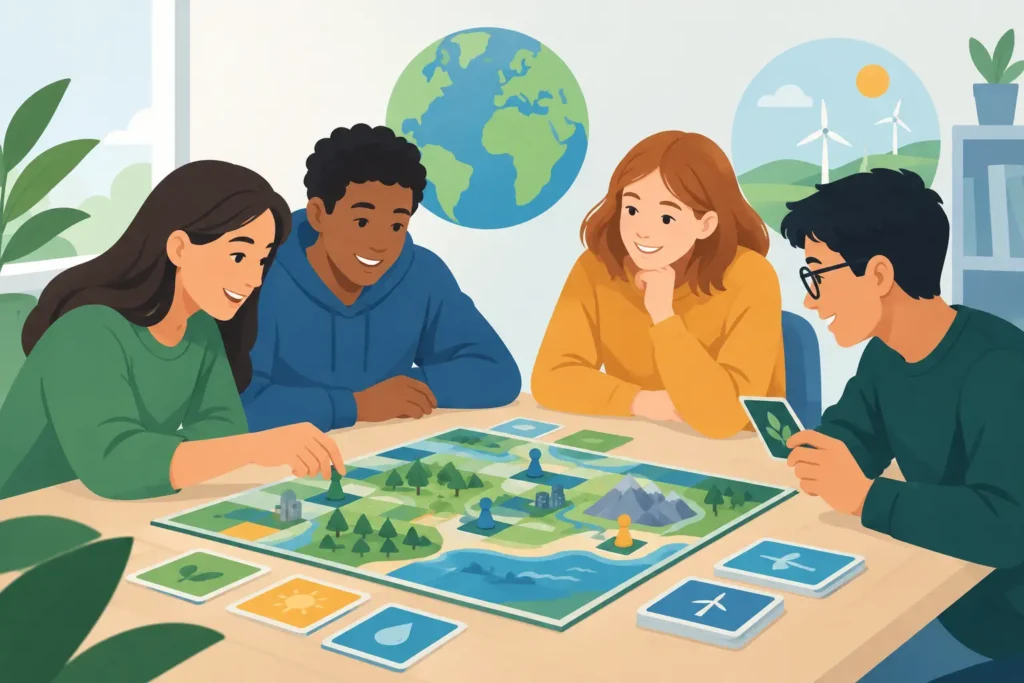
A player has one turn left. Their coastal city is growing, flood defenses are expensive, emissions are still rising, and every decision creates a new trade-off. That moment can teach more climate literacy than a slide full of definitions – if the game is designed to make the consequences legible. To use games for climate literacy well, we have to move beyond climate-themed trivia and build play around systems, choices, and consequences.
Climate change is not difficult to teach because there are no facts available. The facts are everywhere. The hard part is helping people connect cause and effect across time, geography, economics, politics, and everyday behavior. Games are unusually good at that job because they let players test a system, fail safely, revise a strategy, and see what changes.
For Riot Shield Games, that is the standard: play should leave people smarter than when they started. Climate literacy should not feel like homework hidden behind a score counter. It should feel like meaningful action inside a world worth caring about.
What Climate Literacy Actually Requires
Knowing that carbon dioxide traps heat is a useful starting point. It is not climate literacy on its own. A climate-literate player should be able to recognize how energy, land use, infrastructure, consumption, ecosystems, public policy, and equity interact. They should also understand that climate action is not one magic choice with a clean victory screen.
That matters because oversimplified games can teach the wrong lesson. If planting trees instantly fixes emissions, or if one heroic individual saves a city without institutions, budgets, or competing needs, the game may be memorable while still being misleading. A strong learning game respects the complexity of the problem without turning complexity into paralysis.
The goal is not to make players feel guilty for existing. It is to build informed agency. Players need to see where individual choices matter, where collective action matters more, and why some communities face greater risks despite contributing less to the problem.
Use Games for Climate Literacy Through Systems
The most powerful climate game mechanics make invisible systems visible. Resource flows, delayed effects, feedback loops, and trade-offs should not live in a paragraph of exposition. They should show up in what the player can do and what happens next.
A city-building game, for example, can show why cheap, high-emission energy may solve an immediate power shortage while increasing long-term health and climate costs. A farming game can reveal how soil health, drought, crop selection, and market pressure shape one another. A survival adventure can make water access, heat, migration, and community planning part of the core challenge rather than background decoration.
The key is causality. Players should be able to form a hypothesis, make a decision, observe an outcome, and adjust. That cycle turns information into understanding.
Make feedback clear, but not simplistic
Climate systems often move slowly. Games need feedback quickly enough for players to learn, yet honestly enough to reflect reality. The answer is layered feedback. A decision can create an immediate signal, such as lower energy costs or improved public approval, while also affecting longer-term indicators such as air quality, resilience, biodiversity, or cumulative emissions.
Avoid a single generic “green meter” whenever possible. It encourages players to optimize a number instead of understanding a system. Multiple indicators make trade-offs visible. A policy that lowers emissions but increases housing costs may require a second decision to protect vulnerable residents. That is not a design flaw. It is the lesson.
Use uncertainty as a mechanic
Climate futures are shaped by probabilities, not certainties. Droughts, storms, price shifts, and political responses do not arrive on a neat schedule. A game can represent this without becoming random or frustrating.
Give players forecasts, ranges, and imperfect information. Let preparation reduce harm rather than guarantee success. When a flood still damages a well-prepared community, the game can explain why adaptation reduces risk but cannot erase it. That distinction builds a more mature understanding of resilience.
Build Agency Without Selling Fantasy
Climate communication often gets trapped between two bad options: catastrophe that leaves people numb, or optimism so polished that it ignores the scale of the challenge. Games can offer a better path because they make agency active.
Agency is not the same as easy wins. In a good game, players have meaningful choices, understandable goals, and reasons to keep experimenting. They might organize neighbors around a cooling center, redesign a transit network, restore wetlands, negotiate a difficult policy coalition, or balance a limited budget across urgent needs.
The player should feel that action matters, but also learn that action has constraints. That is closer to real climate work. Progress is usually collective, incremental, contested, and still worth pursuing.
Narrative helps here. A neighborhood is more than a statistic when players know its residents, needs, and history. Climate impacts become more understandable when they affect characters with distinct perspectives: a small business owner facing heat-related power costs, a teenager advocating for safer transit, a farmer managing unpredictable seasons, or a planner deciding which areas receive protection first.
Design for Discussion, Not Just Completion
The best climate learning does not end at the credits. It creates questions players want to argue about afterward.
A useful game can ask: Was the player’s solution fair? Who benefited first? What did they sacrifice? Could a different coalition have produced a better outcome? These are not side questions. They are central to climate literacy because climate decisions always involve values alongside data.
For classrooms, families, and community groups, design a short reflection around the game session. Ask players to name one decision they regret, one trade-off they accepted, and one real-world policy or habit the game made easier to understand. The discussion should connect back to the mechanic, not merely repeat climate facts.
This is where games outperform passive content. A player who has struggled to protect a virtual community from heat waves has something concrete to reflect on. They are not being asked to care in the abstract.
What Weak Climate Games Get Wrong
A climate theme alone does not make a game educational. Several common design shortcuts reduce both learning value and player trust.
First, avoid trivia pasted onto unrelated gameplay. Answering a question about renewable energy to earn extra ammunition may raise recall for a moment, but it does not teach why energy systems change slowly or how decisions connect.
Second, do not make players memorize jargon before they can play. Teach terms when the system gives them meaning. “Adaptation,” for instance, lands differently after a player has had to reinforce homes before a storm season.
Third, resist preachy reward structures. If the game labels every choice as morally pure or morally bad, players learn to chase approval rather than think critically. Better design lets players encounter consequences and make an informed case for their strategy.
Finally, be careful with despair. A losing state can be educational when it explains what happened and invites a better attempt. A game that repeatedly says the future is doomed gives players little reason to continue learning or acting.
Test Whether Learning Is Actually Happening
A climate game should be evaluated like a game and like a learning experience. Fun matters because engagement creates time on task. Accuracy matters because misinformation wrapped in attractive design is still misinformation. Transfer matters because players should carry insight beyond the screen.
Test for more than whether players can repeat a fact after a session. Ask whether they can explain a trade-off, predict the likely consequence of a choice, or recognize a similar system in a new scenario. Watch where players become confused. Sometimes confusion points to productive complexity; sometimes it reveals a hidden rule or unclear interface.
Subject-matter experts, educators, and players should all have a voice in this process. Academic grounding strengthens the experience, but it does not replace playtesting. If a mechanic is accurate but tedious, players will not spend enough time with it to learn. If it is exciting but distorts the issue, it needs redesign.
The Standard Worth Building Toward
Climate literacy is not a badge players earn after memorizing a list of environmental terms. It is the ability to see connected systems, weigh imperfect options, understand unequal impacts, and believe that informed action can change outcomes.
Games can teach that because they make consequences playable. Give players a system they can touch, people they can care about, and choices that demand thought. Then let them try again – not because the climate challenge is a game, but because practice is how people learn to act when the stakes are real.