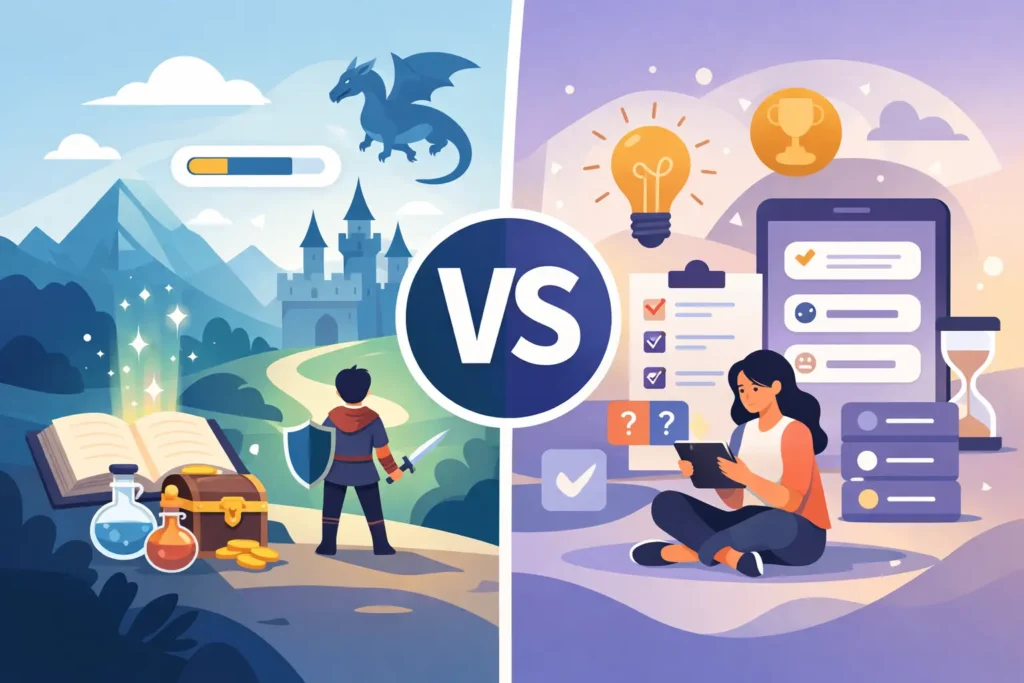
A vocabulary question appears on your phone. You answer correctly, collect a few coins, and move on. Useful? Absolutely. Memorable? Sometimes. But the educational RPG vs quiz apps debate starts when learning needs to survive beyond the next notification – when a player has to use a new word in context, apply a science concept under pressure, or make a financial decision with consequences.
Quiz apps can make practice quick and accessible. Educational RPGs can make knowledge part of the reason players care about what happens next. Neither format automatically creates learning, and neither deserves a free pass just because it uses game-like visuals. The real question is which design turns practice into something players willingly return to, understand, and use.
Educational RPG vs Quiz Apps: The Core Difference
Quiz apps are built around short retrieval loops. A prompt appears, the learner chooses or types an answer, and the app confirms whether it is right. The best versions use repetition, adaptive difficulty, and clean feedback to help learners build recall. That is a real strength. If you need to review Japanese vocabulary on a bus ride or drill formulas before an exam, a focused quiz can be exactly the right tool.
An educational RPG uses a different loop. Knowledge is woven into exploration, dialogue, combat, crafting, puzzles, strategy, or character progression. Instead of answering because a streak demands it, the player uses knowledge because it helps them negotiate with an ally, decode a system, solve a mission, or overcome an obstacle. Learning becomes functional inside a world with stakes.
That difference matters because recall and application are related, but they are not the same skill. Recognizing a word from four choices is valuable. Producing that word while interpreting a conversation, deciding what it means in a new setting, and remembering it several sessions later is a bigger challenge. Well-designed RPG mechanics can create more of those moments.
Where Quiz Apps Earn Their Place
It would be a mistake to treat quiz apps as inferior by default. Their simplicity is often their advantage. They remove setup, make progress visible, and fit into the small pockets of time that usually disappear to scrolling. For learners who are new to a subject, direct practice can reduce cognitive overload. You do not need to learn a map, combat system, inventory, and story before encountering the material.
Quiz apps are especially effective for facts that benefit from frequent retrieval: vocabulary definitions, symbols, dates, formulas, and basic rules. Immediate correction helps prevent errors from becoming habits. A good system also spaces reviews over time rather than endlessly repeating what a learner already knows.
The limitation is that the reward structure can become detached from the subject. Players may optimize for speed, streak protection, or points without building a mental model of why an answer is correct. When every question looks like every other question, learners can also get good at the format rather than good at the underlying skill.
Why RPGs Can Build Stronger Context
An RPG has room to make information meaningful. A language phrase can change how a character responds. A math concept can reveal the best route through a resource problem. A climate decision can reshape a community the player has spent hours getting to know. The lesson is no longer floating outside the game. It is connected to an outcome the player wants.
Context gives memory more places to attach. Rather than meeting a term only on a digital card, the player encounters it in a scene, hears it in dialogue, uses it in a decision, and sees the result. This does not mean a story magically teaches. The instructional material must be accurate, repeated at useful intervals, and integrated clearly enough that the player knows what they learned and why it worked.
The strongest educational RPGs also use productive friction. They do not simply hide a multiple-choice question behind a fantasy interface. They ask players to notice patterns, make choices, test an idea, fail safely, and try again with better understanding. That is closer to the way knowledge works outside a study session.
At Riot Shield Games, that principle guides the work: gameplay should not be a decorative wrapper around a worksheet. The game loop itself should give players a reason to practice language, STEM, finance, or climate literacy until the skill becomes useful.
Motivation Is Not a Cosmetic Feature
People often frame motivation as a bonus, separate from learning. It is not. A learner who returns repeatedly, pays attention, and persists through difficulty gets more opportunities to practice than one who abandons an efficient tool after three days.
RPGs can create that return through curiosity, identity, and agency. Players want to know what lies behind the next door, whether their build will work, and what happens to characters they care about. Progress feels personal because choices feel personal. When educational tasks support that momentum instead of interrupting it, repetition stops feeling like a chore.
Quiz apps use motivation too, usually through streaks, badges, leaderboards, and visible daily goals. These can be effective, particularly for habit formation. But external rewards have a ceiling. If the activity underneath remains thin, a broken streak can feel like permission to quit. A compelling game world gives players another reason to come back.
The Trade-Offs Are Real
Educational RPGs ask more of both creators and players. They require meaningful systems, polished pacing, accessible onboarding, and curriculum that fits the mechanics rather than fights them. A weak educational RPG can be the worst of both worlds: a shallow game interrupted by obvious lessons.
They also take time. A learner who needs to memorize twenty terms before tomorrow morning may get more immediate value from a quiz app than from a two-hour quest. RPGs are better suited to sustained engagement and deeper practice, not every learning objective or every schedule.
Quiz apps have their own risk. Their efficiency can create an illusion of mastery. Checking the right answer feels satisfying, but learners need opportunities to retrieve without cues, explain their reasoning, and apply knowledge in unfamiliar situations. The format works best when it is paired with richer use of the material.
What to Look for in an Educational Game
The label “educational” says very little on its own. Parents, educators, and self-directed learners should look past the subject claim and examine the learning loop. Four questions reveal a lot:
- Does the player repeatedly use the target skill, rather than answer occasional trivia between unrelated gameplay?
- Is feedback specific enough to explain mistakes and support a better next attempt?
- Does difficulty rise as competence grows, or does the game stay easy to protect engagement?
- Can the player apply the knowledge in a new context, not just repeat the same prompt?
For language learning, this might mean moving from recognition to listening, reading, recall, and meaningful choice. For finance, it means seeing how trade-offs affect a budget instead of memorizing definitions. For STEM, it means experimenting with systems and reasoning through outcomes, not merely selecting the correct answer after a flashy animation.
Measured progress matters, too. Games should make improvement visible without reducing every learning moment to a score. A player deserves to know whether they are gaining durable skills, not just accumulating in-game currency.
Use the Format That Matches the Mission
For fast review, low-friction daily practice, and narrowly defined recall goals, quiz apps are hard to beat. They are compact training tools. For learners who need context, persistence, decision-making, and a reason to spend meaningful time with difficult material, an educational RPG can offer something bigger: practice that feels like play because it genuinely is play.
The best approach is often not choosing a side forever. Use a quiz app to sharpen the building blocks. Use an RPG to make those building blocks matter. When a player can recall the answer, use it under pressure, and feel proud of what it helped them accomplish, screen time has become more than a distraction. It has become progress worth pursuing.