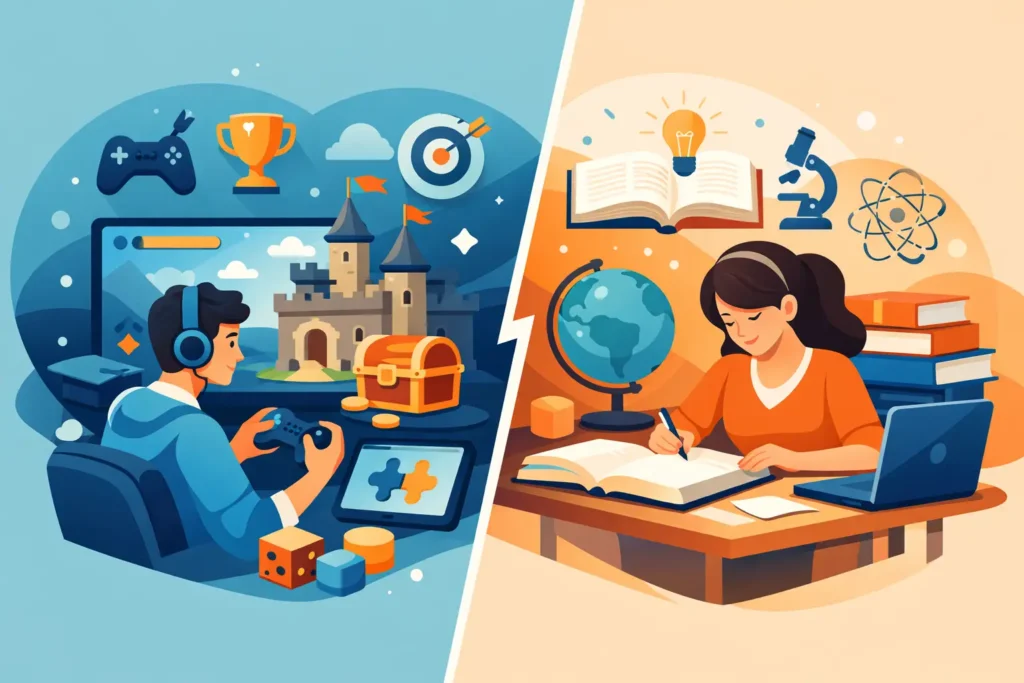
A student can reread a page on photosynthesis three times, highlight every bold term, and still freeze when asked why plants need sunlight. Put that same student in a game where a virtual ecosystem collapses unless they balance energy, water, and carbon, and the concept suddenly has consequences. That is the real question behind game based learning versus textbooks: not whether one is more entertaining, but which experience helps knowledge survive contact with the real world.
Textbooks remain powerful tools. They offer depth, structure, and a reliable record of what learners are expected to know. But they often ask students to supply their own motivation, feedback loop, and sense of progress. Well-designed games build those elements into the experience. They make learning active, visible, and worth another attempt.
Game Based Learning Versus Textbooks Is Not a Fair Fight
Comparing a great textbook to a great educational game is more useful than comparing paper to screens. The medium is not the magic. Design is.
A weak game can be a worksheet wearing a cartoon costume. It may reward fast tapping, repeat trivia without context, or interrupt every minute with a lesson that has nothing to do with play. A weak textbook can bury a fascinating subject under dense prose and end-of-chapter questions that reward recall more than understanding.
The difference is what each format asks the learner to do. Textbooks usually present information first and ask learners to apply it later. Games can introduce a challenge first, then make information necessary to overcome it. In one format, knowledge is often the destination. In the other, knowledge can become equipment.
That matters because people remember what they use. A vocabulary list may tell a learner that a Japanese word means “train station.” A game can require that learner to recognize the word under pressure, choose the right route, recover from a wrong turn, and try again. The word is no longer a disconnected fact. It is part of a decision.
Why Gameplay Can Make Learning Stick
The strongest learning games do not merely add points to school content. They use game mechanics to create conditions that traditional study often struggles to provide.
Feedback arrives when it matters
A textbook answer key might tell learners they missed question seven after they have completed a whole section. A game can respond instantly. Make the wrong financial decision, mistranslate a phrase, or miscalculate a science problem, and the system changes around you.
Immediate feedback is not about making learning easy. It is about making mistakes useful. Players can see what failed, adjust their strategy, and test a new approach before the lesson fades from memory. That cycle of attempt, feedback, and revision is how skill develops in games, sports, music, coding, and serious academic work.
Repetition has a reason
Repetition is unavoidable in language learning, math, and personal finance. The problem is not repetition itself. The problem is repetition with no purpose beyond getting through a deck of cards.
Games can turn repeated practice into progression. Players revisit a concept because they want to improve a build, solve a puzzle, protect a team, or reach a new area. The underlying educational task remains demanding, but the reason to persist comes from inside the experience. That is a major shift from “I have to study this” to “I want one more try.”
Learners become decision-makers
Textbooks can explain systems beautifully, but games let players operate inside them. A climate lesson becomes more memorable when decisions about energy, transportation, consumption, and policy produce visible trade-offs. A budgeting lesson becomes sharper when every choice affects resources, risk, and future options.
This is especially valuable for subjects that are hard to understand in isolation. STEM, finance, and climate literacy are not collections of facts. They are systems. Games can model systems in ways that let players test hypotheses and experience cause and effect.
What Textbooks Still Do Better
The case for game-based learning should not become an excuse to dismiss textbooks. Textbooks excel at sustained explanation. They can slow down a complex idea, define terms carefully, present evidence, and guide a learner through a subject in a deliberate sequence.
They are also easier to scan, annotate, revisit, and use as a reference. When a college student needs to compare theories, study a detailed diagram, or trace an argument across several chapters, a well-organized textbook can be more efficient than a game. Not every learning objective needs a boss battle.
Textbooks also support deep reading, a skill worth protecting. Reading a challenging passage and following an argument without constant stimulation builds concentration. Games should not replace that practice. They should create a stronger bridge between explanation and application.
For educators, textbooks offer predictability. They align with curricula, provide shared material for an entire class, and make it easier to verify coverage. A game that has not been designed around clear learning outcomes may be exciting but difficult to assess. Fun alone is not evidence of learning.
Where Educational Games Can Fail
Game-based learning has real trade-offs. Development is expensive, and good educational design takes more than adding quizzes between levels. The learning goal must be connected to the player’s actual decisions. If players can win while ignoring the target skill, the game is teaching the wrong lesson.
There is also a risk of cognitive overload. A player who is managing controls, story, visual effects, timers, and new academic vocabulary may retain less than a learner working with a simple page. The answer is not to make games dull. It is to introduce complexity with intention and give players room to reflect.
Access matters, too. Devices, internet connections, classroom time, and teacher support vary widely. Textbooks have practical advantages when technology is unavailable or when a learner needs a quiet, low-distraction study option.
The best game-based learning experiences respect these limits. They do not claim that play is automatically superior. They prove their value through meaningful mechanics, measurable progress, and subject matter that holds up outside the game.
The Better Model: Learn, Play, Apply
For most learners, the strongest answer is not game based learning versus textbooks as an either-or choice. It is a smarter sequence.
Start with a concise explanation that establishes the core concept. Move into gameplay that requires learners to use that concept repeatedly in context. Then return to reflection, discussion, writing, or problem-solving that helps them name what they learned and transfer it beyond the game.
A language learner might read a short grammar explanation, use the pattern in a puzzle or role-playing scenario, then write or speak original sentences. A student studying climate systems might review the science, manage a simulation with competing priorities, then explain why a particular strategy succeeded or failed. The game provides the pressure and practice. The follow-up turns experience into explicit understanding.
This model also gives educators better evidence. Instead of asking only whether students enjoyed the activity, they can look at decisions made in the game, errors corrected over time, and performance on related tasks afterward. Engagement matters, but engagement is the engine, not the finish line.
At Riot Shield Games, that is the standard worth building toward: games with real gameplay, real intellectual challenge, and learning that earns its place in the experience. Players deserve more than entertainment disguised as education. They deserve games that leave them smarter than when they started.
Choose the Tool Based on the Skill
Use a textbook when learners need careful explanation, extended reading, detailed reference material, or a stable path through a large body of knowledge. Use game-based learning when they need practice, feedback, motivation, systems thinking, or a safe place to make meaningful mistakes.
For memorization-heavy subjects, games can make repetition more sustainable. For procedural skills, they can provide practice without the cost of real-world failure. For abstract systems, they can make invisible relationships visible. But for nuanced arguments, original sources, and dense conceptual reading, textbooks remain essential.
The goal is not to make every lesson feel like a game. The goal is to stop treating effortful learning as if boredom were proof of rigor. Give learners a challenge worth caring about, feedback they can act on, and knowledge they can use. Then let them play, learn, and level up.